
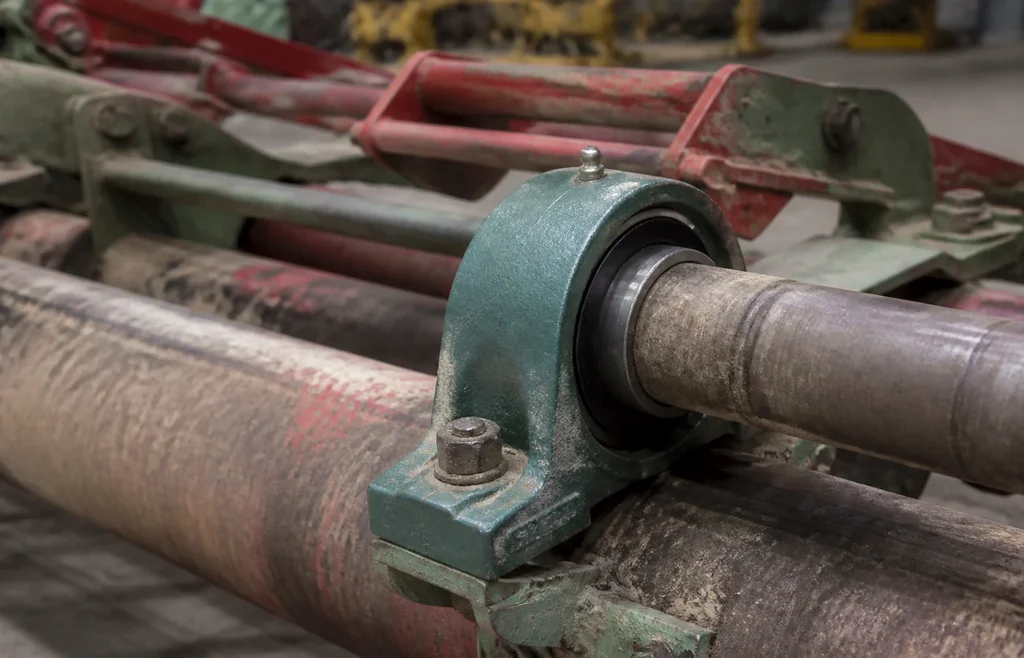
Dimensional and installation data for the 40 mm bore size of UCP200 Series Pillow Block Units, dimensioned to ISO 3228 / JIS B 1559. Selection is by bore diameter — the bearing designation is what the shaft is machined to — so the figures below start with the boundary dimensions and go on to the fits, the clearance and the mounting method that make them work.
40 mm Bore Dimensional Row (ISO 3228 / JIS B 1559)
| Designation | Shaft bore d (mm) | Height to shaft centre H (mm) | Bolt hole centres J (mm) | Overall length L (mm) | Housing material |
|---|---|---|---|---|---|
| UCP208 | 40 | 49.2 | 137 | 184 | Grey cast iron |
What a UCP200 Series Pillow Block Units Does
A housed unit is a complete mounted bearing: an insert bearing with a wide inner ring, its housing, its seals and its grease, ready to bolt down. It clamps onto a commercial-tolerance shaft with setscrews or an eccentric collar, and the insert's spherical outer surface takes up the misalignment between two bolted feet — so a conveyor or a fan can be built without machining a bearing seat at all.
Primarily radial load, with a limited axial capacity in both directions. Treat the axial figure as a secondary rating, not as a thrust rating.
Speed at 40 mm Bore
No limiting speed is tabulated for this product. Where speed matters, the figure to work to is the one the bearing supplier states for the exact design, cage and lubricant supplied — not a family value.
Mounting a 40 mm Bore UCP200 Series Pillow Block Units
The insert bearing clamps onto the shaft with setscrews or an eccentric locking collar; the shaft needs only a commercial tolerance (h6 to h9), not a ground bearing seat. That is what makes a housed unit quick to install, and it is also its limitation: a setscrew grip transmits far less torque than an interference fit and can fret or creep on the shaft under reversing or heavily shocked load, where a keyed or interference-fitted arrangement should be used instead.
Where a 40 mm Bore UCP200 Series Pillow Block Units Is Used
At a 40 mm bore, ucp200 series pillow block units are typically found in industrial gearboxes, fans and blowers, conveyor drives, pump and compressor shafts and machine tool spindles, where the load and the heat generated both start to decide the arrangement.
Failure Modes and What They Look Like
- Subsurface fatigue (spalling) — a flake of raceway lifts out and the bearing gets noisy and rough. This is the failure the L10 life calculation predicts — if it arrives near the calculated life the bearing did its job, and if it arrives early the load, the fit or the lubrication was not what the calculation assumed.
- Inadequate lubrication — a polished, then discoloured, then torn raceway, running hot with a darkened grease. It is the most common cause of early failure by a wide margin, and the interval, not the grease, is usually what was wrong.
- Contamination — dents in the raceway with raised edges, then premature spalling from those dents. Wear particles, casting sand and washdown water all do it; sealing and filtration are what prevent it.
- False brinelling and fretting — evenly spaced dull marks at ball or roller pitch, produced by vibration while the shaft is stationary — a machine that travels on a truck, or a standby pump beside a running one. It is not caused by overload and cannot be cured by fitting a bigger bearing.
- Shaft fretting under the setscrews — a polished, reddish band on the shaft under the inner ring and a unit that loosens repeatedly. The setscrew grip was asked to hold against reversing torque that needs a key or an interference fit.
- Seal failure — grease escaping, then water and dirt getting in. A contact seal is a wearing part with a temperature limit of its own, and a washdown at 80 °C will get past a standard nitrile lip long before the bearing itself is in trouble.
Where NOT to Use a UCP200 Series Pillow Block Units
- Do not use a setscrew insert bearing under reversing or heavily shocked torque. The grip is a friction one; it frets and creeps, and the shaft ends up polished and undersized. Use a keyed shaft, an adapter sleeve unit, or a plummer block.
- Do not use the unit's self-alignment as a substitute for parallel feet. It takes up static misalignment between two seats; it does not survive a soft foot or a base that flexes under load.
- Do not specify a standard cast iron unit for a washdown line. The housing corrodes, the standard seals let water in, and the correct answer is a stainless or composite unit with the right seal package.
- Do not treat a sealed bearing as sealed for life in a wet or hot environment. A contact seal has a temperature and a pressure limit of its own, and once it is past them the grease leaves and the water arrives.
Stepping Up or Down from 40 mm
Within the same series, the next bore up in this series is 45 mm and the next bore down is 35 mm. Changing bore changes the shaft, so it is the last thing to change: when the calculated life at 40 mm is short, the first move is to a heavier diameter series at the SAME bore — the 6300 envelope instead of the 6200, for instance — which raises the rating without touching the shaft. The second is to change type: a roller bearing carries far more radial load than a ball bearing of the same envelope.



