
Manufacturing
Cold heading, thread rolling, CNC machining, stamping and secondary operations for standard and custom hardware.
We manufacture and supply standard and made-to-order bearings for equipment manufacturers, engineering companies, distributors and industrial projects worldwide.
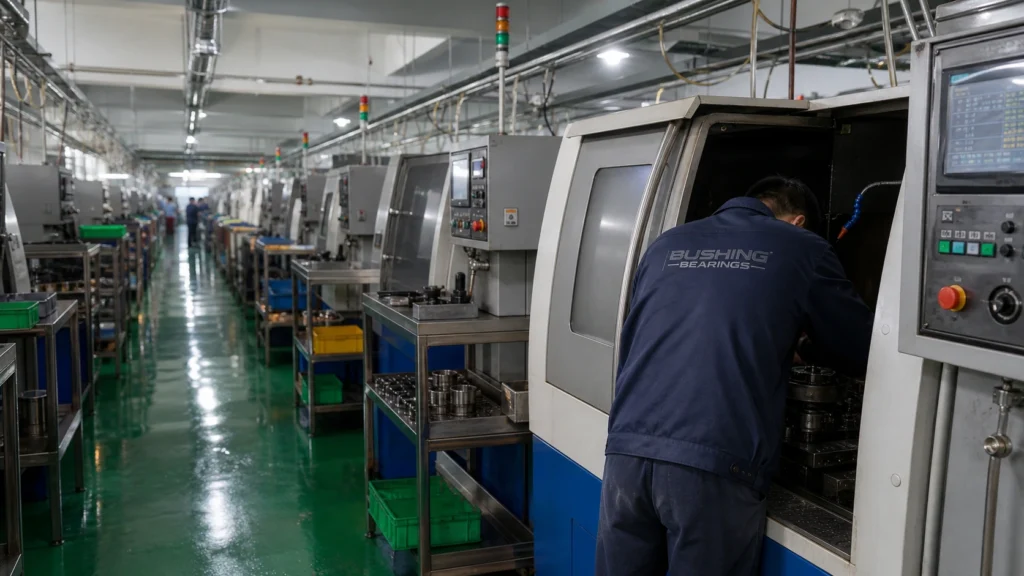
Our factory produces rolling and plain bearings: deep groove and angular contact ball bearings, tapered, cylindrical, spherical and needle roller bearings, thrust bearings, insert bearings and housed units, plain bushings and precision balls. Production is organized around stable processes, controlled raceway geometry and dependable batch-to-batch clearance and noise levels.
Cold forming, thread rolling, machining, heat treatment, surface finishing, inspection and packing are coordinated to meet the requirements of each drawing, standard and application. Standard products and custom parts can be supplied across a wide range of sizes, materials and finishes.
Cold heading, thread rolling, CNC machining, stamping and secondary operations for standard and custom hardware.
Carbon steel, alloy steel, stainless steel, brass, aluminum and other materials selected for the intended working environment.
Mechanical properties and corrosion protection are controlled through suitable heat-treatment and surface-finishing processes.
Dimensions, threads, hardness, mechanical properties, coating and appearance are checked according to the product specification.
Every bearing we ship moves through the same six stages, in our own plant. The controls listed under each stage are the ones that decide whether a bearing holds its tolerance class, its clearance group and its noise grade — not marketing copy.

GCr15 bar and tube is cut, heated and forged into ring blanks, then turned to leave a uniform grinding allowance. Forging rather than machining from solid keeps the grain flow following the raceway, which is the surface that eventually fails.
Blank dimensions and grinding stock checked at set-up and per shift.
Through-hardening brings GCr15 / 100Cr6 to 58–64 HRC; carburizing case-hardens 20CrMnTi where the section is heavy or the load is shock. Rings are then stabilized so they hold size in service rather than growing in the housing.
Core and surface hardness per lot; retained austenite and dimensional stability to the ordered temperature class.
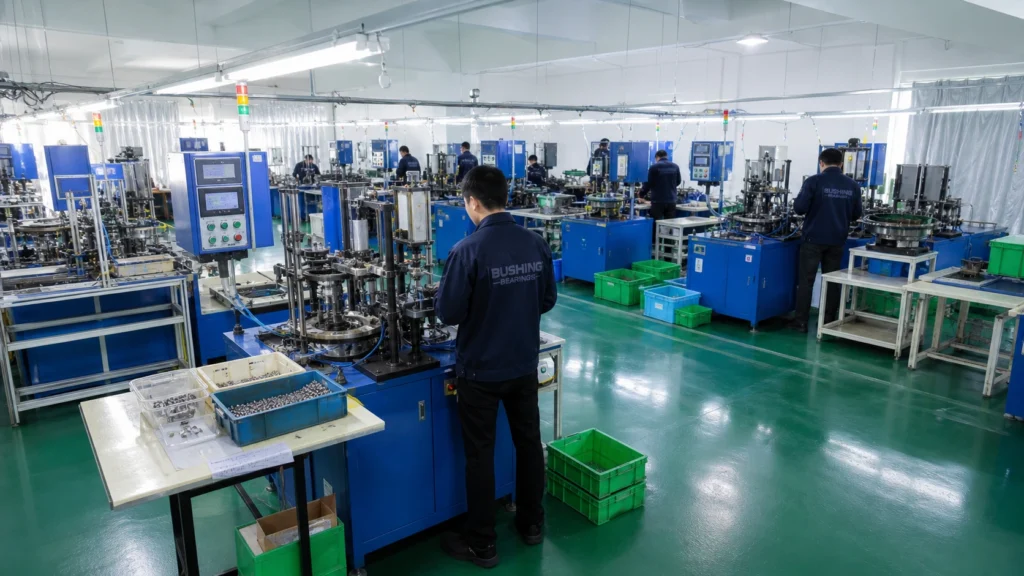
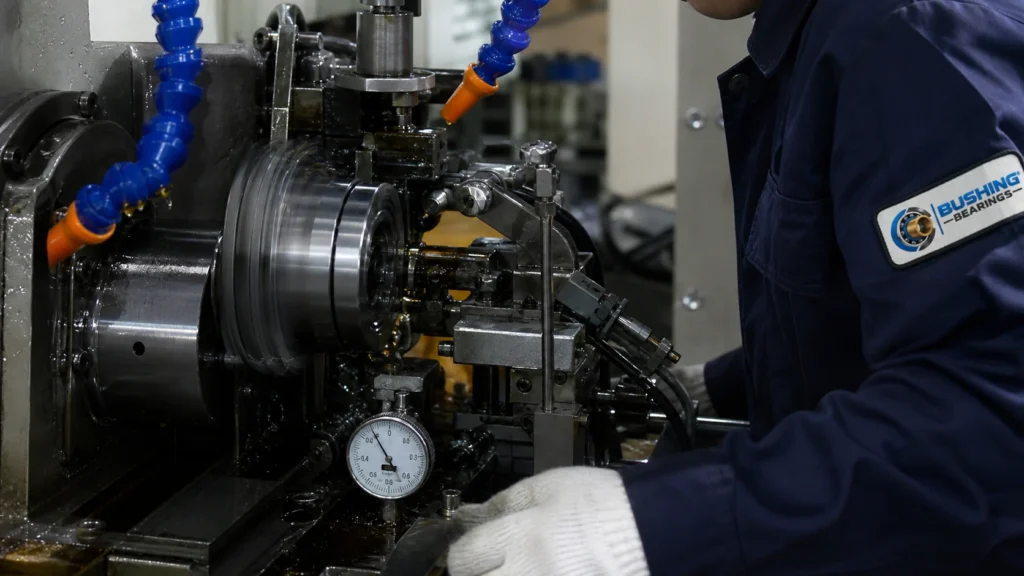
Faces, bore, outer diameter and raceway are ground in sequence on separate machines. This is where the tolerance class is created: P0, P6, P5 or P4 is a grinding outcome, not a sorting outcome.
Bore and outer diameter deviation, raceway roundness and face runout measured to ISO 492 on every setup.
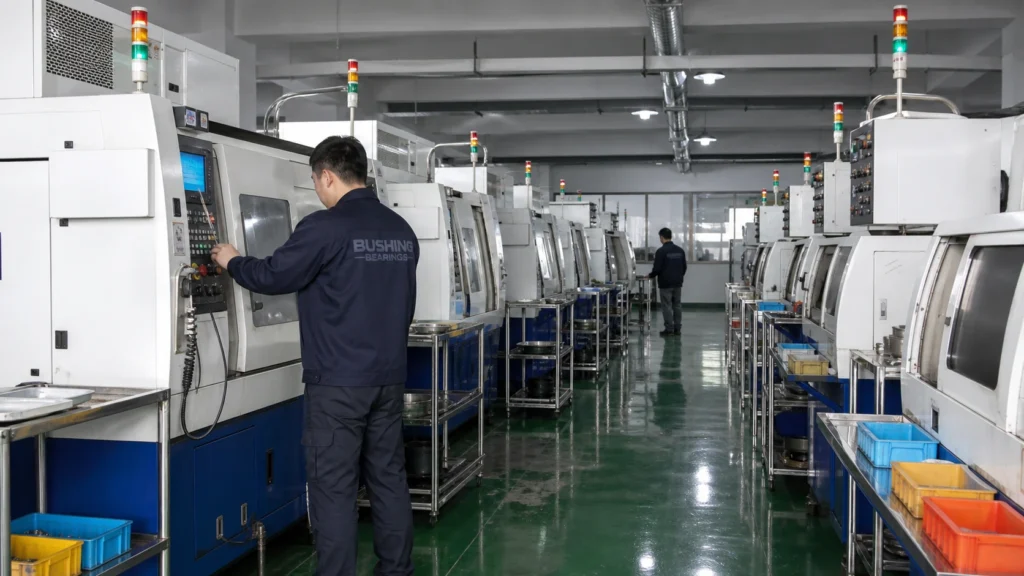
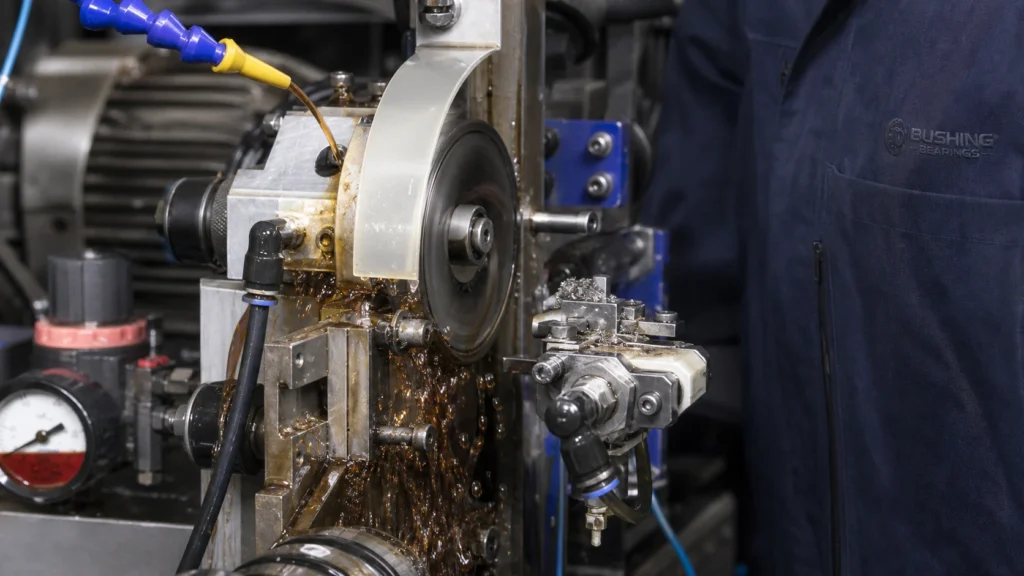
The ground raceway is honed to remove the grinding lay and bring surface roughness down to a fraction of a micrometre. Raceway finish is what decides whether a lubricant film forms, and therefore what decides bearing life far more than the load rating alone.
Surface roughness Ra and waviness measured per lot.
Rings, rolling elements and cage are matched, and the rolling elements are selected by size group to land the radial internal clearance in the group ordered — C2, CN, C3 or C4. Seals or shields are pressed in and the bearing is greased to the specified fill.
Radial internal clearance gauged on every bearing to ISO 5753-1; grease weight verified.
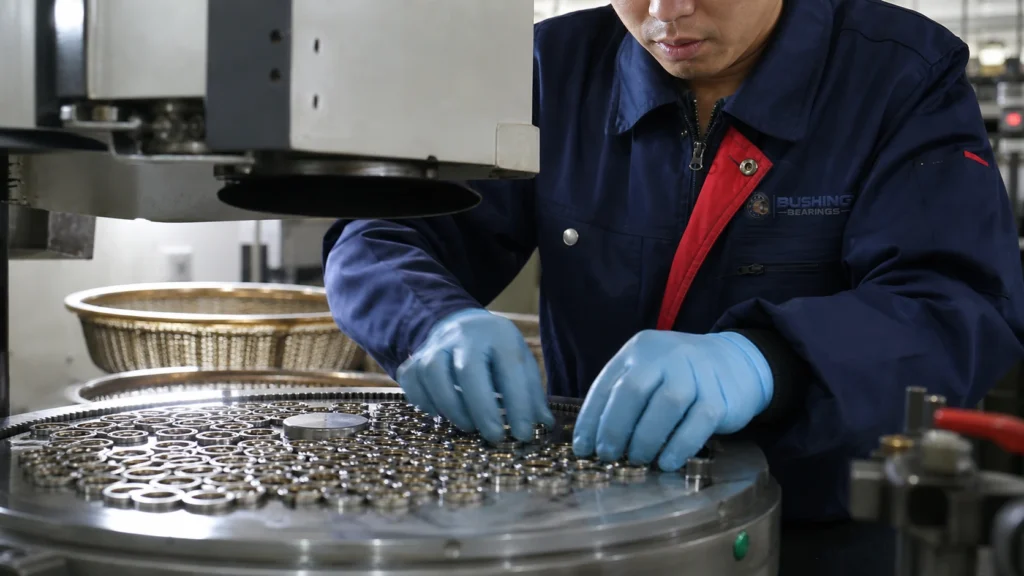
Every bearing is run on a vibration stand and graded Z1 / Z2 / Z3, because a bearing that is dimensionally perfect and noisy is a warranty return. It is then rust-preventive coated, wrapped and boxed to your part numbering, with the lot number travelling in the carton.
Vibration level per bearing; lot traceability from carton back to the steel heat number.
We supply products to widely used ISO, DIN, ANSI/ASME and other industrial standards. When a standard item does not fit the application, our team can review drawings, samples and technical requirements for custom production.
Material grade, tolerance class, radial internal clearance, boundary dimensions, cage and seal type, noise and vibration level, marking, testing, packaging and documentation can be confirmed before production.
Share the standard number, drawing, material, finish, quantity and delivery requirements. Our team will review the details and prepare a quotation.