
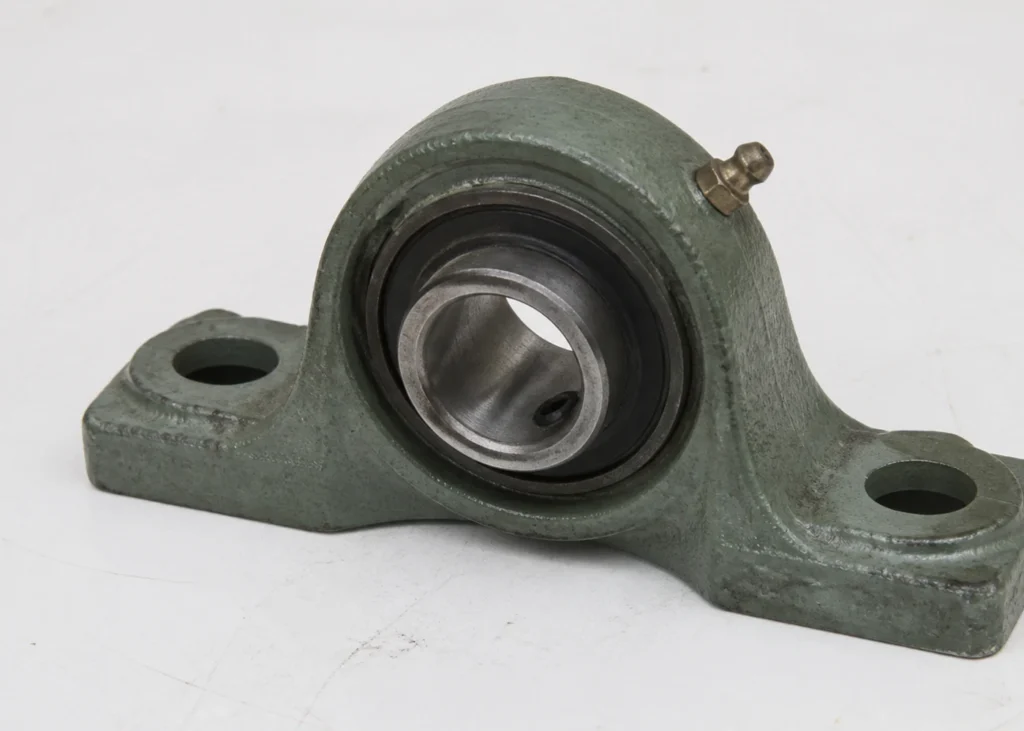
Manufactured to ISO 3228 / JIS B 1559, UCP200 Series Pillow Block Units are insert bearings & housed units supplied by Bushing Bearings. Every designation in the series is listed with its boundary dimensions; the interactive half-section drawing redraws itself for whichever size you select.
What Are UCP200 Series Pillow Block Units?
UCP200 Series Pillow Block Units are insert bearings & housed units defined by ISO 3228 / JIS B 1559. They are selected by bearing designation and the dimensional characteristics shown below. Material, cage and sealing are specified separately from the designation and are covered further down this page.
Materials & Cage
The insert bearing is through-hardened GCr15 / 100Cr6 with a spherical outer ring. The housing is a separate material decision: grey cast iron for general industrial duty, ductile iron where shock is expected, pressed steel for light duty and low mass, thermoplastic or 304 stainless for washdown and food service. Seals are normally nitrile; specify FKM above 100 degrees C.
Typical Applications
Conveyors, agricultural equipment, fans and general OEM machinery, bolted straight to a frame with no machined housing bore. Read the full application guide for UCP200 Series Pillow Block Units →
Pricing
UCP200 Series Pillow Block Units are supplied to order. Pricing starts from approximately US$6.00 per piece for standard shaft sizes with a grey cast iron housing and setscrew locking; final pricing depends on size, material, finish and order quantity (MOQ applies). Submit your exact configuration with the quote form above.
Specifying the UCP200 Series Pillow Block Units
If the shaft is already fixed, go straight to the size: 55 mm bore, 60 mm bore, 65 mm bore and 70 mm bore. Each of those pages repeats only the row that matters for that bore, with the fit and clearance notes underneath it.
Material changes what this bearing tolerates far more than it changes what it costs. GCr15 Bearing Steel, Martensitic Stainless 440C and Cast Iron set out the trade-off for each grade in the same terms.
For the machines and duties this type is actually specified for, see where ucp200 series pillow block units are fitted.
Manufactured in our own plant
This bearing is forged, hardened, ground, superfinished and clearance-set in-house. The stages below are where its tolerance class, its internal clearance and its noise grade are actually decided.
-

01 Forging & turning
GCr15 bar and tube is cut, heated and forged into ring blanks, then turned to leave a uniform grinding allowance. Forging rather than machining from solid keeps the grain flow following the raceway, which is the surface that eventually fails.
Blank dimensions and grinding stock checked at set-up and per shift.
-
02 Heat treatment
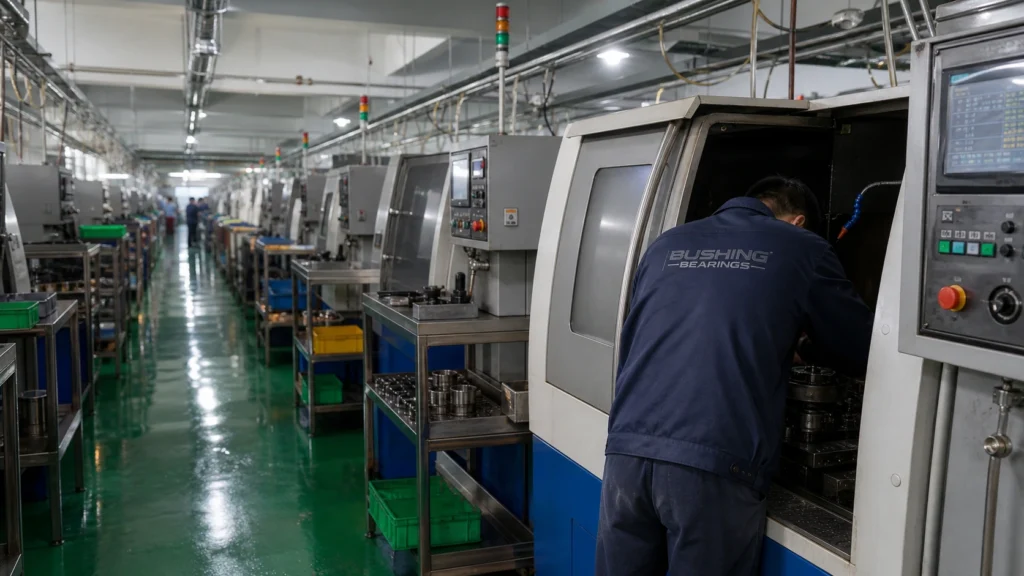
Through-hardening brings GCr15 / 100Cr6 to 58–64 HRC; carburizing case-hardens 20CrMnTi where the section is heavy or the load is shock. Rings are then stabilized so they hold size in service rather than growing in the housing.
Core and surface hardness per lot; retained austenite and dimensional stability to the ordered temperature class.
-
03 Raceway grinding
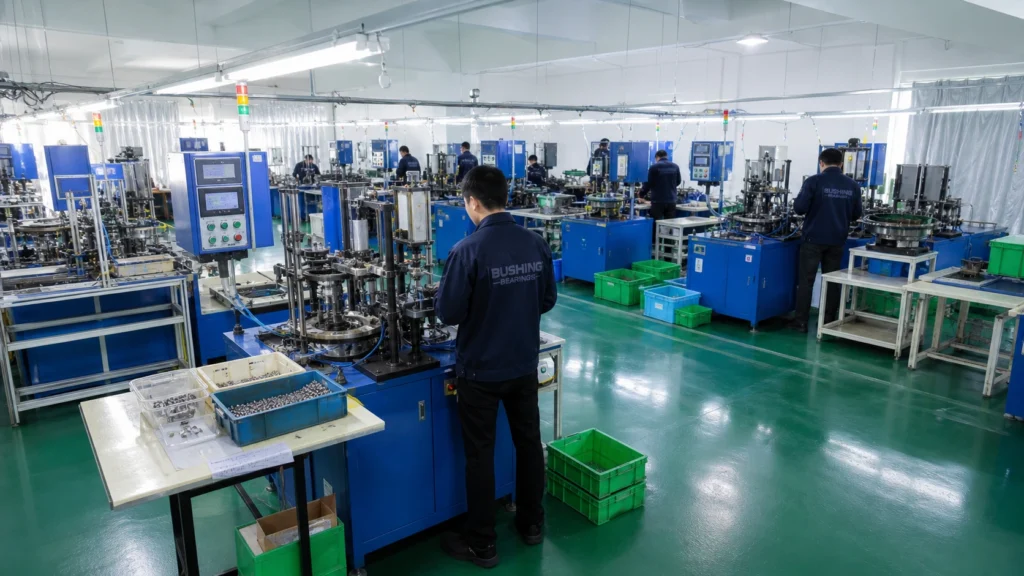
Faces, bore, outer diameter and raceway are ground in sequence on separate machines. This is where the tolerance class is created: P0, P6, P5 or P4 is a grinding outcome, not a sorting outcome.
Bore and outer diameter deviation, raceway roundness and face runout measured to ISO 492 on every setup.
-
04 Honing & superfinishing
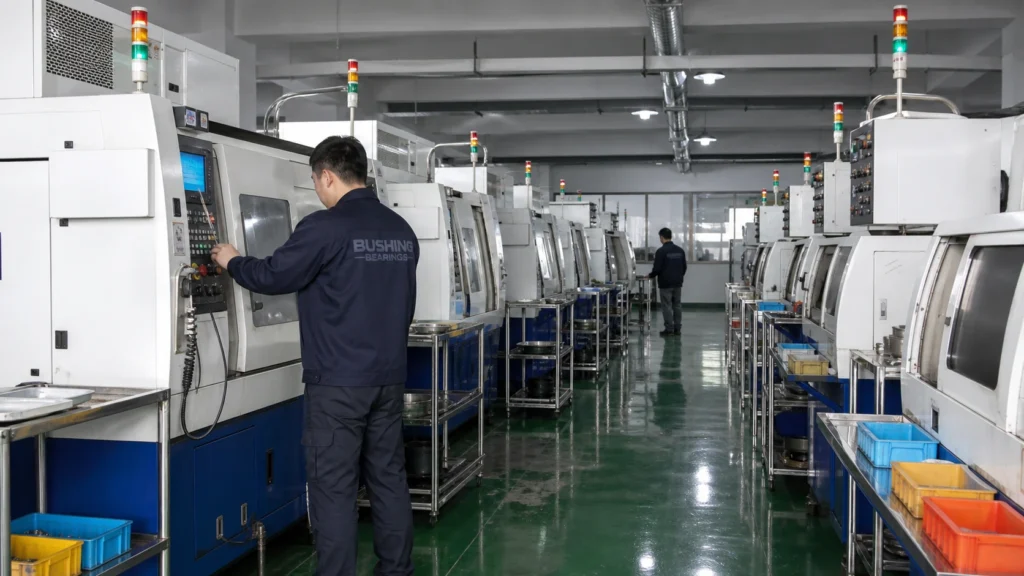
The ground raceway is honed to remove the grinding lay and bring surface roughness down to a fraction of a micrometre. Raceway finish is what decides whether a lubricant film forms, and therefore what decides bearing life far more than the load rating alone.
Surface roughness Ra and waviness measured per lot.