Skip to content
info@bushingbearings.com +86 15999653684

Angular Contact Ball Bearings · ISO 15 / DIN 628-1 / GB/T 292

Martensitic Stainless 440C 7300C Series Angular Contact Ball Bearings

Grade, hardness, corrosion behavior, service temperature and the full bore range for this material.

Martensitic Stainless 440C 7300C Series Angular Contact Ball Bearings are made from AISI 440C = X105CrMo17 (1.4125), hardened and tempered — the only common stainless hard enough to form a rolling raceway. Corrosion behavior: good in water, steam, mild chemicals and food service; it is a hardenable stainless, so it holds less chromium in solution than 304 and will stain in standing chlorides. The material is magnetic, and the usable service range is about -30 °C to +180 °C in ordinary bearing service, the lubricant usually deciding before the steel does. In practice this material is the standard corrosion-resistant bearing steel; a stainless bearing is rated below the same envelope in GCr15, so take its load ratings from the stainless table and never from the chrome steel one.

Material
AISI 440C = X105CrMo17 (1.4125), hardened and tempered — the only common stainless hard enough to form a rolling raceway
Corrosion resistance
Good in water, steam, mild chemicals and food service; it is a hardenable stainless, so it holds less chromium in solution than 304 and will stain in standing chlorides
Magnetic response
Magnetic
Service temperature
about -30 °C to +180 °C in ordinary bearing service, the lubricant usually deciding before the steel does

Property figures are typical for the material. In an assembled bearing the lubricant, the seals and the cage frequently reach their limits before the material does, so check all four against the duty. Material certification is available on request for production orders.

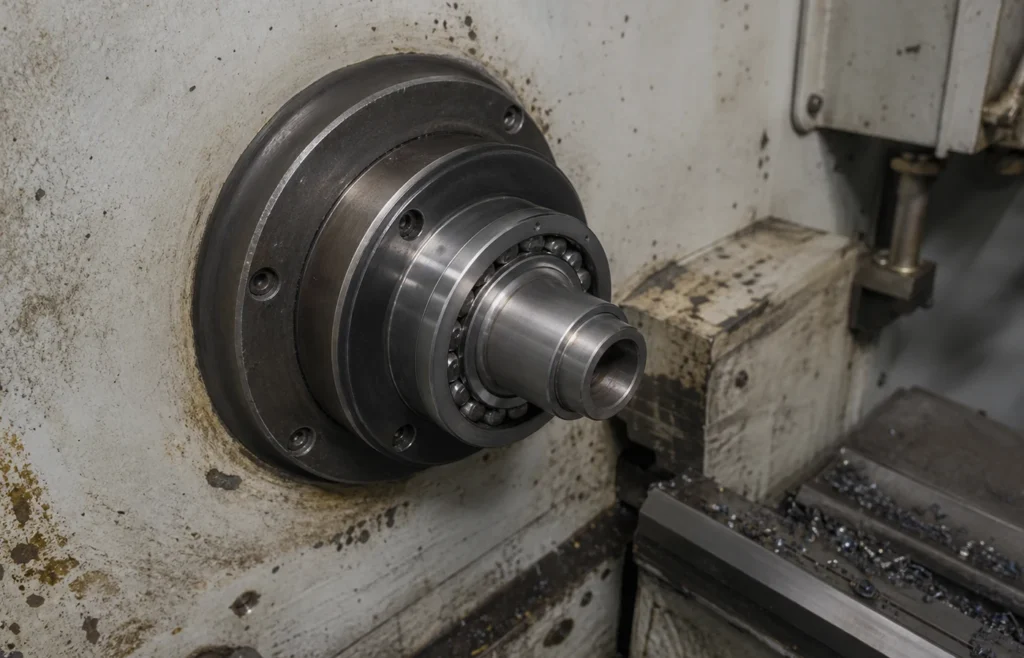
Machine tool spindle bearing — 7300C Series Angular Contact Ball Bearings in service

Martensitic Stainless 440C is the ring and rolling element steel of the corrosion-resistant version — the standard corrosion-resistant bearing steel; a stainless bearing is rated below the same envelope in GCr15, so take its load ratings from the stainless table and never from the chrome steel one. On a 7300c series angular contact ball bearings that matters because good in water, steam, mild chemicals and food service; it is a hardenable stainless, so it holds less chromium in solution than 304 and will stain in standing chlorides. The property data, the comparison against the alternatives and the size table are below.

Why Martensitic Stainless 440C for 7300C Series Angular Contact Ball Bearings

The standard corrosion-resistant bearing steel; a stainless bearing is rated below the same envelope in GCr15, so take its load ratings from the stainless table and never from the chrome steel one. In a 7300c series angular contact ball bearings it is the ring and rolling element steel of the corrosion-resistant version.

It is the compromise that makes a corrosion-resistant rolling bearing possible: enough carbon to be hardened to a raceway hardness, enough chromium to resist water and mild chemicals. Everything else about the bearing — the envelope, the tolerance class, the clearance group — is unchanged.

Material Properties

Grade designationAISI 440C = X105CrMo17 (1.4125), hardened and tempered — the only common stainless hard enough to form a rolling raceway
Magnetic responseMagnetic
Service temperatureAbout -30 °C to +180 °C in ordinary bearing service, the lubricant usually deciding before the steel does
Corrosion characteristicGood in water, steam, mild chemicals and food service; it is a hardenable stainless, so it holds less chromium in solution than 304 and will stain in standing chlorides

Service Limits

A martensitic stainless bearing is rated below the same envelope in chrome steel and it is not stainless in the way 316 is: it is corrosion RESISTANT, and standing salt water, chlorides or long wet periods will still pit it. It is also softer at temperature than GCr15. Take the ratings from the stainless table, and where the environment is genuinely aggressive, consider a full ceramic bearing or a polymer housed unit instead.

What the Material Changes About the Bearing

The envelope is unchanged and the bearing drops into the same seat, but the load ratings are not the chrome steel ratings and must not be carried across. Expect a lower rating, a slightly lower temperature ceiling, and — in exchange — a bearing that survives the wash, the condensation or the food process that would rust a standard one.

Fitting a Steel Bearing in an Aluminum Housing

Aluminum has roughly twice the coefficient of thermal expansion of bearing steel, so a housing bore machined to a normal H7 fit at room temperature grows away from the outer ring as the machine reaches operating temperature. The outer ring then turns in its seat and wears the bore. Where the housing is aluminum and the temperature rise is more than about 30 degrees C, tighten the housing fit by one grade — J7 or K7 in place of H7 — or fit a steel sleeve into the aluminum. Check the resulting internal clearance: a tighter housing fit takes clearance out of the bearing, which is often why C3 is specified alongside it.

Sizes of 7300C Series Angular Contact Ball Bearings Available in Martensitic Stainless 440C

DesignationBore d (mm)Outer diameter D (mm)Width B (mm)Chamfer r min (mm)Contact angle a (deg)
7300C1035110.615
7301C123712115
7302C154213115
7303C174714115
7304C2052151.115
7305C2562171.115
7306C3072191.115
7307C3580211.515
7308C4090231.515
7309C45100251.515
7310C5011027215
7311C5512029215
7312C60130312.115
7313C65140332.115
7314C70150352.115
7315C75160372.115
7316C80170392.115
7317C8518041315
7318C9019043315
7319C9520045315
7320C10021547315

Technical Drawing

Customize the parameters below — every spec field is editable, and the drawing redraws to match the values you choose. Changing the designation snaps the other fields to that size's standard values; you can then override any individual value.

Sends the selected values to the quote form below.
Our facility

The numbers come off our own machines

Every ring is gauged for bore and outside diameter, every assembly for radial internal clearance to ISO 5753-1, and every finished bearing for vibration. That is why the values on this page are quotable rather than indicative.

Bearing production line, wide view
Ring inspection station
Bearing assembly and clearance setting
Finished bearings staged for packing

Request a Quote

The form below follows the current technical drawing configuration. Change the drawing values above and the request details update automatically.

Request a Quotation

Specification
Business Information

Dimensions & Specifications (ISO 15 / DIN 628-1 / GB/T 292)

DesignationBore d (mm)Outer diameter D (mm)Width B (mm)Chamfer r min (mm)Contact angle a (deg)
7300C1035110.615
7301C123712115
7302C154213115
7303C174714115
7304C2052151.115
7305C2562171.115
7306C3072191.115
7307C3580211.515
7308C4090231.515
7309C45100251.515
7310C5011027215
7311C5512029215
7312C60130312.115
7313C65140332.115
7314C70150352.115
7315C75160372.115
7316C80170392.115
7317C8518041315
7318C9019043315
7319C9520045315
7320C10021547315

Video: Martensitic Stainless 440C 7300C Series Angular Contact Ball Bearings

Third-party video, selected automatically for this topic. It is not produced by Bushing Bearings and is not a specification source — use the tables on this page for dimensional data.

Frequently Asked Questions

What are the limits of Martensitic Stainless 440C?

A martensitic stainless bearing is rated below the same envelope in chrome steel and it is not stainless in the way 316 is: it is corrosion RESISTANT, and standing salt water, chlorides or long wet periods will still pit it. It is also softer at temperature than GCr15. Take the ratings from the stainless table, and where the environment is genuinely aggressive, consider a full ceramic bearing or a polymer housed unit instead.

What should I use instead of Martensitic Stainless 440C?

If the load matters more than the corrosion, go back to GCr15 with the right seals and a corrosion-inhibiting grease — a sealed chrome steel bearing outlasts a stainless one in many "wet" applications that are only occasionally wet. If the corrosion matters more than the load, go past stainless: a full ceramic or a polymer-housed bearing does not corrode at all.

Does Martensitic Stainless 440C change the dimensions or the rating?

The envelope is unchanged and the bearing drops into the same seat, but the load ratings are not the chrome steel ratings and must not be carried across. Expect a lower rating, a slightly lower temperature ceiling, and — in exchange — a bearing that survives the wash, the condensation or the food process that would rust a standard one.

Is a stainless bearing suitable for food processing?

Martensitic 440C is the usual raceway material for a corrosion-resistant bearing and is widely used in food machinery, with a food-grade grease and the appropriate seals. Where the wash is aggressive or standing chlorides are present, a full ceramic bearing or a polymer housed unit is the more durable answer than any hardenable stainless.

How do I request a quotation?

Use the technical drawing on this page to pick the exact configuration, then submit it with the quote form. We respond within one business day.


