
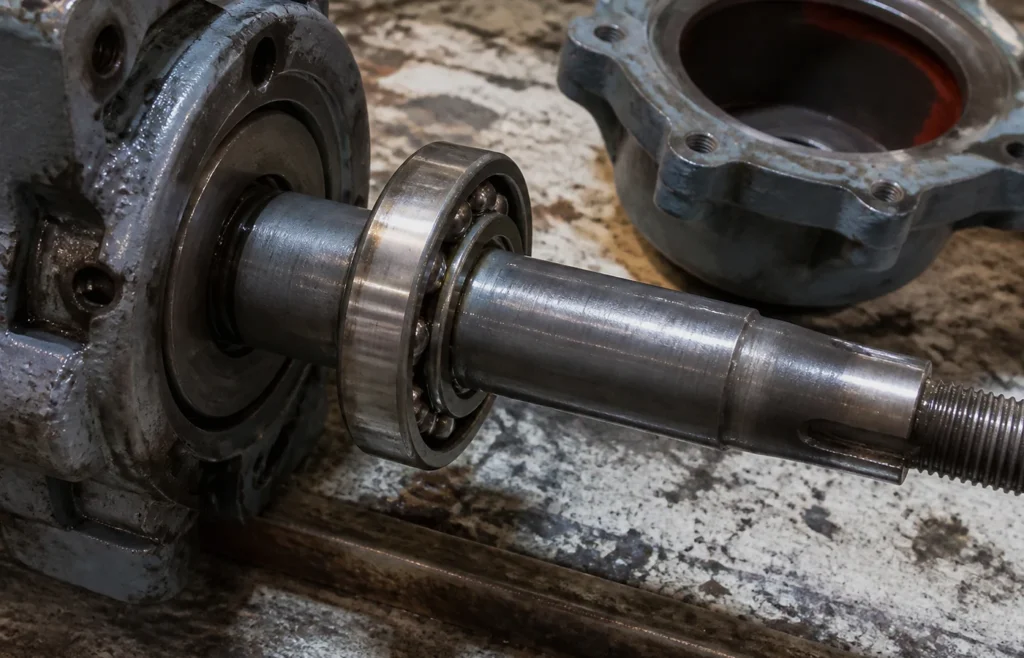
Zirconia ZrO2 is the rolling element material — the balls, with the rings left in steel in a hybrid bearing — tougher but softer and less stiff than silicon nitride — it is the full-ceramic choice for wet and chemically aggressive service rather than the high-speed one. On a 7300c series angular contact ball bearings that matters because inert, including in seawater, brine and many acids. The property data, the comparison against the alternatives and the size table are below.
Why Zirconia ZrO2 for 7300C Series Angular Contact Ball Bearings
Tougher but softer and less stiff than silicon nitride — it is the full-ceramic choice for wet and chemically aggressive service rather than the high-speed one. In a 7300c series angular contact ball bearings it is the rolling element material — the balls, with the rings left in steel in a hybrid bearing.
Zirconia is chosen where the environment attacks steel — seawater, brine, chemicals, or a process that must not be contaminated by iron — and where a full-ceramic bearing running unlubricated or with the process fluid is the only workable arrangement.
Material Properties
| Grade designation | yttria-stabilized zirconia to ASTM F2393, density about 6.0 g/cm³ |
|---|---|
| Magnetic response | Non-magnetic, and an electrical insulator |
| Service temperature | Stable well beyond the rest of the bearing; its thermal expansion is closer to steel than silicon nitride, which makes a mixed steel/zirconia assembly less sensitive to temperature change |
| Corrosion characteristic | Inert, including in seawater, brine and many acids |
Service Limits
Zirconia is less hard and less stiff than silicon nitride, and its load capacity in a full-ceramic bearing is well below a steel bearing of the same size. Full ceramic bearings also run with much lower speed limits than their steel equivalents. Specify one when the chemistry demands it, not when the load or the speed does.
What the Material Changes About the Bearing
In a hybrid bearing the rings stay steel and the balls become ceramic, so the boundary dimensions and the mounting are unchanged. The differences are all dynamic: lower ball mass and therefore lower centrifugal load at speed, a higher permissible speed, less heat generated, electrical insulation through the ball contact, and a bearing that tolerates marginal lubrication better than an all-steel one.
Fitting a Steel Bearing in an Aluminum Housing
Aluminum has roughly twice the coefficient of thermal expansion of bearing steel, so a housing bore machined to a normal H7 fit at room temperature grows away from the outer ring as the machine reaches operating temperature. The outer ring then turns in its seat and wears the bore. Where the housing is aluminum and the temperature rise is more than about 30 degrees C, tighten the housing fit by one grade — J7 or K7 in place of H7 — or fit a steel sleeve into the aluminum. Check the resulting internal clearance: a tighter housing fit takes clearance out of the bearing, which is often why C3 is specified alongside it.
Sizes of 7300C Series Angular Contact Ball Bearings Available in Zirconia ZrO2
| Designation | Bore d (mm) | Outer diameter D (mm) | Width B (mm) | Chamfer r min (mm) | Contact angle a (deg) |
|---|---|---|---|---|---|
| 7300C | 10 | 35 | 11 | 0.6 | 15 |
| 7301C | 12 | 37 | 12 | 1 | 15 |
| 7302C | 15 | 42 | 13 | 1 | 15 |
| 7303C | 17 | 47 | 14 | 1 | 15 |
| 7304C | 20 | 52 | 15 | 1.1 | 15 |
| 7305C | 25 | 62 | 17 | 1.1 | 15 |
| 7306C | 30 | 72 | 19 | 1.1 | 15 |
| 7307C | 35 | 80 | 21 | 1.5 | 15 |
| 7308C | 40 | 90 | 23 | 1.5 | 15 |
| 7309C | 45 | 100 | 25 | 1.5 | 15 |
| 7310C | 50 | 110 | 27 | 2 | 15 |
| 7311C | 55 | 120 | 29 | 2 | 15 |
| 7312C | 60 | 130 | 31 | 2.1 | 15 |
| 7313C | 65 | 140 | 33 | 2.1 | 15 |
| 7314C | 70 | 150 | 35 | 2.1 | 15 |
| 7315C | 75 | 160 | 37 | 2.1 | 15 |
| 7316C | 80 | 170 | 39 | 2.1 | 15 |
| 7317C | 85 | 180 | 41 | 3 | 15 |
| 7318C | 90 | 190 | 43 | 3 | 15 |
| 7319C | 95 | 200 | 45 | 3 | 15 |
| 7320C | 100 | 215 | 47 | 3 | 15 |



