Skip to content
info@bushingbearings.com +86 15999653684

Plain & Spherical Plain Bearings · ISO 3547-1 / DIN 1494 · Application guide

What Are SF-2 Series Bronze-Backed Composite Bushings Used For?

Typical applications, the industries that specify sf-2 series bronze-backed composite bushings in 12 mm to 50 mm bore, how to state the designation, clearance, sealing, cage and fit on an order, and where a different bearing type is the right answer.

SF-2 Series Bronze-Backed Composite Bushings are used for providing a plain sliding bearing surface in a housing bore, carrying load with no rolling elements at all in the smallest possible radial section. Boundary dimensions are to ISO 3547-1 / DIN 1494, and selection is driven by the bearing material and lining, by the pv limit for the load and sliding speed, and by the housing bore and shaft that together set the running clearance.

Primary duty
Providing a plain sliding bearing surface in a housing bore, carrying load with no rolling elements at all in the smallest possible radial section
Load direction
Radial sliding load; axial only on a flanged type, against the flange face
Bore range
12 mm to 50 mm
Boundary dimensions
ISO 3547-1 / DIN 1494
Category
Plain & Spherical Plain Bearings

Application notes are general engineering guidance. Basic load ratings, limiting speeds and permissible misalignment vary between manufacturers for the same designation — verify them against the catalog of the bearing actually being supplied, and against your own bearing life calculation.

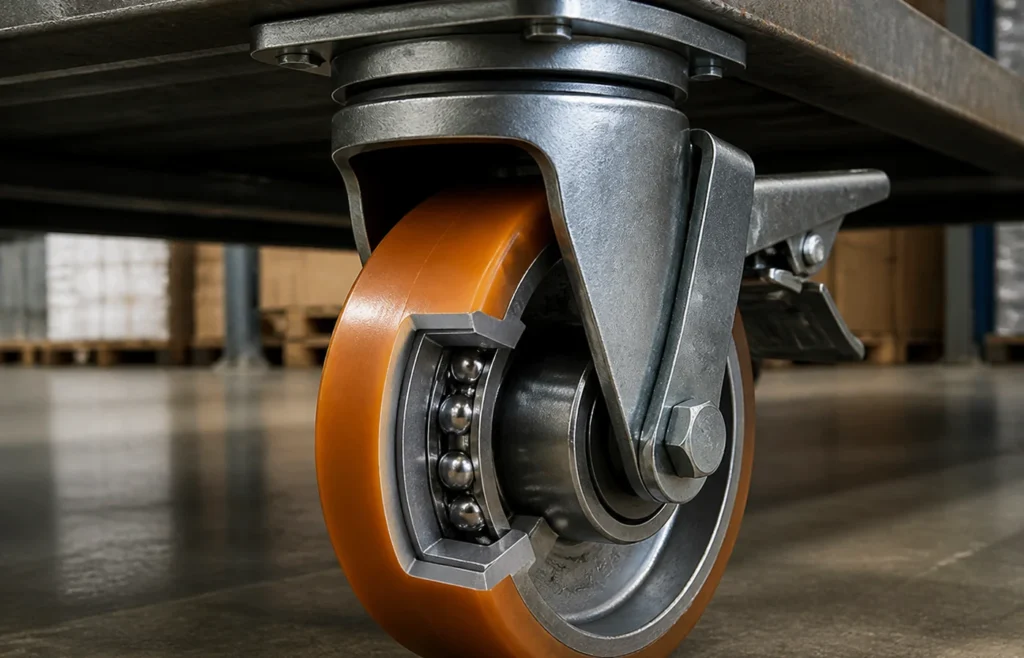
Caster wheel bearing — a typical application for SF-2 Series Bronze-Backed Composite Bushings
A typical service position for SF-2 Series Bronze-Backed Composite Bushings.

Application guide for SF-2 Series Bronze-Backed Composite Bushings to ISO 3547-1 / DIN 1494. The core duty of the type is providing a plain sliding bearing surface in a housing bore, carrying load with no rolling elements at all in the smallest possible radial section. A sleeve of bearing material — wrapped bronze, composite with a PTFE lining, sintered bronze carrying oil in its pores, or bronze with graphite plugs — takes its finished bore from the housing it is pressed into. The typical industries, the specification checklist, mounting practice and the exclusion cases are set out below. This series is catalogued from 12 mm to 50 mm bore; the full table of boundary dimensions is further down the page.

Typical Applications for SF-2 Series Bronze-Backed Composite Bushings

The machine positions and sectors where this type is specified:

  • Pumps and fluid equipment: guide bushings running in the process fluid, where a greased bearing is not acceptable.
  • Machine slides and dampers: guided sliding motion where a low, constant friction matters more than efficiency.
  • Appliances and light mechanisms: quiet, cheap, low-load pivots in high volume.
  • Maintenance and repair (MRO): replacing a failed bearing where the original designation, clearance group and sealing have to be matched exactly.
  • OEM machine building: designed-in shaft support on new equipment, specified from the load, speed and envelope at the design stage.

How to Specify SF-2 Series Bronze-Backed Composite Bushings for Your Application

  • Bore: Start from the bore the shaft or housing gives you — this series is catalogued from 12 mm to 50 mm — then check the outer diameter and width against the space available. The boundary dimensions are fixed by the standard, so they are the same from any manufacturer; the load ratings and limiting speeds are not, and belong to the specific bearing being supplied.
  • Lining and backing: A wrapped bushing is a steel or bronze backing strip with a bearing lining rolled into a sleeve. Specify the lining (PTFE composite, sintered bronze, POM) because it sets the pv limit, the temperature range and whether the bushing is lubricated or dry.
  • Material and lining: Wrapped bronze for general duty with grease; a steel-backed PTFE composite for maintenance-free running; sintered bronze impregnated with oil where the pores supply the lubricant; solid bronze with graphite plugs for high load at high temperature. The material is the specification — everything else follows from it.
  • pv limit: A plain bearing is rated by contact pressure multiplied by sliding speed. Check the load and speed combination against the pv limit for the specific liner, at the operating temperature; it is the number that decides whether the bushing survives.
  • Running clearance: A wrapped bushing is supplied slightly oversize and takes its finished bore from the housing when it is pressed in. The housing bore tolerance and the shaft tolerance together produce the running clearance, so both belong on the drawing.
  • Designation and suffixes: State the complete designation including every suffix. The base number gives the type and the boundary dimensions; the suffixes carry the sealing, the cage, the clearance group, the tolerance class and any special execution — and two bearings whose base numbers match but whose suffixes differ are not interchangeable.
  • Clearance and tolerance: State the running clearance or fit class the assembly requires, together with the tolerances of the mating parts that produce it. For this type the clearance is created by the parts around the bearing rather than being built into it, which is precisely why it has to be written down.
  • Sealing arrangement: This type is supplied open, so the sealing belongs to the housing around it. Specify the shaft seal, flinger or labyrinth that will keep the lubricant in and contamination out — with an open bearing, the sealing arrangement, not the bearing, decides how long it survives its environment.
  • Cage: not applicable: This part has no cage and no rolling elements to separate, so the equivalent decision is the sliding material or liner. That is stated above, and it plays the same role: it is what sets the temperature limit and the lubrication requirement.
  • Shaft and housing fit: Specify the seat tolerances, not just the bearing. The rule is that the ring which rotates relative to the load direction takes the interference fit: for a rotating inner ring under normal radial load the shaft seat is typically k5 or k6 with the housing bore H7, and where the outer ring rotates the interference moves to the housing (N7 or P7) with a clearance fit (g6) on the shaft. Heavier loads and hollow shafts move the fits tighter. A correctly chosen bearing in the wrong fit fails anyway — too loose and the ring creeps and frets its seat, too tight and the interference consumes the internal clearance and the bearing runs preloaded.
  • Standard: Boundary dimensions are to ISO 3547-1 / DIN 1494. Quoting the standard on the order guarantees the mounting dimensions are interchangeable between suppliers — it does not standardize load ratings, limiting speeds or internal design, which remain manufacturer-specific.

Mounting & Assembly Practice

  • Press in with a piloted mandrel over the full bore, square to the housing face. A bushing started at an angle shaves the housing bore and never seats.
  • Do not ream or machine a wrapped composite bushing after fitting: the lining is thin, and cutting through it removes the bearing surface. The bore is produced by the press fit, by design.
  • Specify the shaft finish and hardness — a plain bearing runs against the shaft, and a rough or soft shaft wears the bushing rather than the other way round.
  • Where a lubrication groove or hole is provided, orient it into the unloaded zone; a groove in the load zone removes bearing area exactly where it is needed.

Common Selection Mistakes with SF-2 Series Bronze-Backed Composite Bushings

  • Reaming a composite bushing to size after pressing it in, which cuts through the lining.
  • Ignoring the pv limit and sizing on load alone, so the bushing survives the load and fails on sliding speed.
  • Greasing a bushing whose lining is designed to run dry, which lets dust stick in the sliding gap.
  • Sizing this bearing from the boundary dimensions alone. Load ratings and limiting speeds are manufacturer-specific for this series and are deliberately not published here — take them from the catalog of the bearing actually being supplied and calculate the life against them.

Where SF-2 Series Bronze-Backed Composite Bushings Are Not the Right Choice

  • Do not machine the bore after fitting — the lining is a few tenths of a millimetre thick and machining removes it.
  • No misalignment capability whatsoever — a cylindrical bushing loads its edge as soon as the shaft tilts. Where the joint articulates, use a spherical plain bearing.
  • Not for high speed at high load: the pv limit is reached long before any strength limit.
  • Not for precision running clearance; the bore is created by the fit, and the clearance band is wider than a rolling bearing.
  • Not where continuous low friction under load is required — starting friction is far higher than a rolling bearing, which is the usual reason a mechanism sticks.
  • This type will not tolerate misalignment. The rolling or sliding contact is a line, so a fraction of a degree of tilt moves the whole load onto the end of the contact and the stress concentration there is what fails the bearing.
Marine propeller shaft bushing — a typical application for SF-2 Series Bronze-Backed Composite Bushings
Another position where SF-2 Series Bronze-Backed Composite Bushings are specified.

Technical Drawing

Customize the parameters below — every spec field is editable, and the drawing redraws to match the values you choose. Changing the designation snaps the other fields to that size's standard values; you can then override any individual value.

Sends the selected values to the quote form below.

Request a Quote

The form below follows the current technical drawing configuration. Change the drawing values above and the request details update automatically.

Request a Quotation

Specification
Business Information
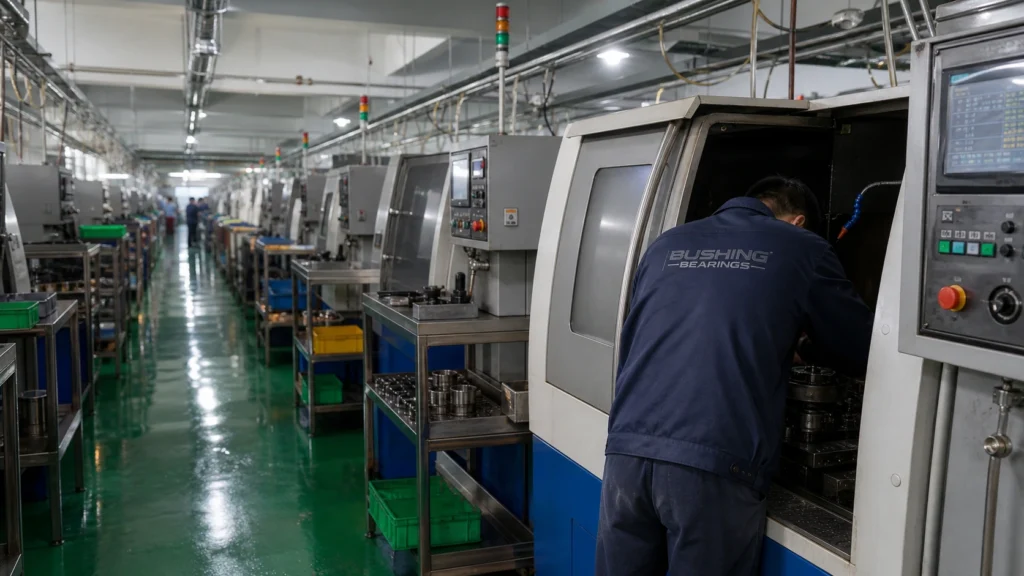
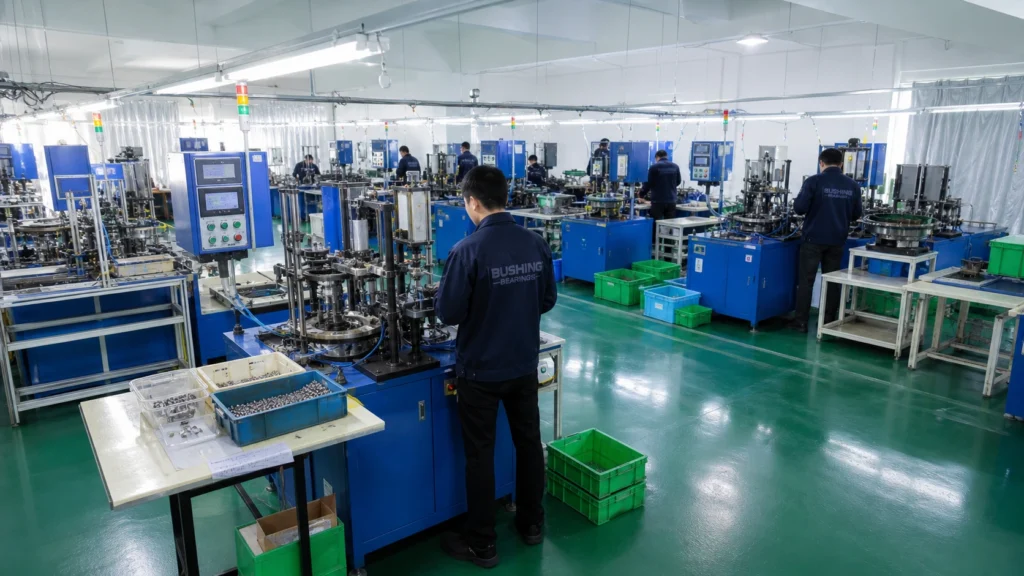
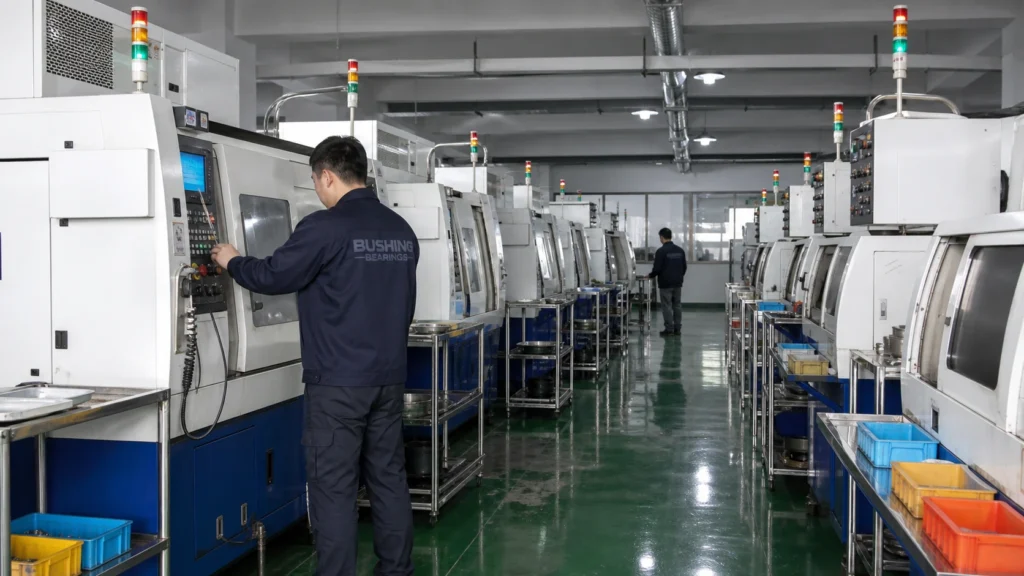
Our facility

Who makes the bearing behind this application

These are not resold from stock. Rings are forged and hardened here, raceways ground and superfinished here, and clearance set against the group you order — which is what makes a run repeatable a year later.

Bearing production line, wide view
Ring inspection station
Bearing assembly and clearance setting
Finished bearings staged for packing

Dimensions & Specifications (ISO 3547-1 / DIN 1494)

DesignationBore d (mm)Outer diameter D (mm)Length B (mm)Wall thickness (mm)LiningBackingOperating temperature range (u00b0C)Lubrication
SF-2 12121214121.0POM with grease pocketsCuSn6 bronze-40 to +110Initial grease charge
SF-2 15151517151.0POM with grease pocketsCuSn6 bronze-40 to +110Initial grease charge
SF-2 16151618151.0POM with grease pocketsCuSn6 bronze-40 to +110Initial grease charge
SF-2 18201820201.0POM with grease pocketsCuSn6 bronze-40 to +110Initial grease charge
SF-2 20202023201.5POM with grease pocketsCuSn6 bronze-40 to +110Initial grease charge
SF-2 25202528201.5POM with grease pocketsCuSn6 bronze-40 to +110Initial grease charge
SF-2 30303034302.0POM with grease pocketsCuSn6 bronze-40 to +110Initial grease charge
SF-2 35303539302.0POM with grease pocketsCuSn6 bronze-40 to +110Initial grease charge
SF-2 40304044302.0POM with grease pocketsCuSn6 bronze-40 to +110Initial grease charge
SF-2 50405055402.5POM with grease pocketsCuSn6 bronze-40 to +110Initial grease charge

Video: What Are SF-2 Series Bronze-Backed Composite Bushings Used For? in use

Selecting Composite Bushings

Third-party video, selected automatically for this topic. It is not produced by Bushing Bearings and is not a specification source — use the tables on this page for dimensional data.

Inside the plant

Manufactured in our own plant

This bearing is forged, hardened, ground, superfinished and clearance-set in-house. The stages below are where its tolerance class, its internal clearance and its noise grade are actually decided.

  1. Bearing ring blanks coming off the forging press
    01

    Forging & turning

    GCr15 bar and tube is cut, heated and forged into ring blanks, then turned to leave a uniform grinding allowance. Forging rather than machining from solid keeps the grain flow following the raceway, which is the surface that eventually fails.

    Blank dimensions and grinding stock checked at set-up and per shift.

  2. Bearing rings entering a continuous hardening furnace
    02

    Heat treatment

    Through-hardening brings GCr15 / 100Cr6 to 58–64 HRC; carburizing case-hardens 20CrMnTi where the section is heavy or the load is shock. Rings are then stabilized so they hold size in service rather than growing in the housing.

    Core and surface hardness per lot; retained austenite and dimensional stability to the ordered temperature class.

  3. Raceway grinding machine finishing a bearing inner ring
    03

    Raceway grinding

    Faces, bore, outer diameter and raceway are ground in sequence on separate machines. This is where the tolerance class is created: P0, P6, P5 or P4 is a grinding outcome, not a sorting outcome.

    Bore and outer diameter deviation, raceway roundness and face runout measured to ISO 492 on every setup.

  4. Superfinishing stones acting on a ground raceway
    04

    Honing & superfinishing

    The ground raceway is honed to remove the grinding lay and bring surface roughness down to a fraction of a micrometre. Raceway finish is what decides whether a lubricant film forms, and therefore what decides bearing life far more than the load rating alone.

    Surface roughness Ra and waviness measured per lot.

Frequently Asked Questions

What are SF-2 Series Bronze-Backed Composite Bushings used for?

Providing a plain sliding bearing surface in a housing bore, carrying load with no rolling elements at all in the smallest possible radial section. A sleeve of bearing material — wrapped bronze, composite with a PTFE lining, sintered bronze carrying oil in its pores, or bronze with graphite plugs — takes its finished bore from the housing it is pressed into. Boundary dimensions are to ISO 3547-1 / DIN 1494.

Which industries use SF-2 Series Bronze-Backed Composite Bushings?

They are commonly specified in hydraulic cylinders, agricultural and construction machinery and pumps and fluid equipment, among other sectors.

Do I need to ream a bushing after pressing it in?

Not on wrapped and composite bushings — they are supplied slightly oversize precisely so the press fit produces the finished bore, and machining afterward cuts through a lining only a fraction of a millimetre thick. Solid bronze bushings are sometimes finished after fitting, but only where the drawing calls for it.

What is a pv limit?

The product of contact pressure and sliding speed, which is what a plain bearing is really rated on. A bushing can be well within its load rating and still fail because the shaft speed puts the combination beyond the pv limit for the liner. Check both together, at the actual operating temperature.

Can I get a quote for SF-2 Series Bronze-Backed Composite Bushings in the size and specification I need?

Yes. Use the technical drawing and quote form on this page to set the size and options, then send the exact configuration — designation, clearance, sealing and cage — to our team for pricing and lead time.