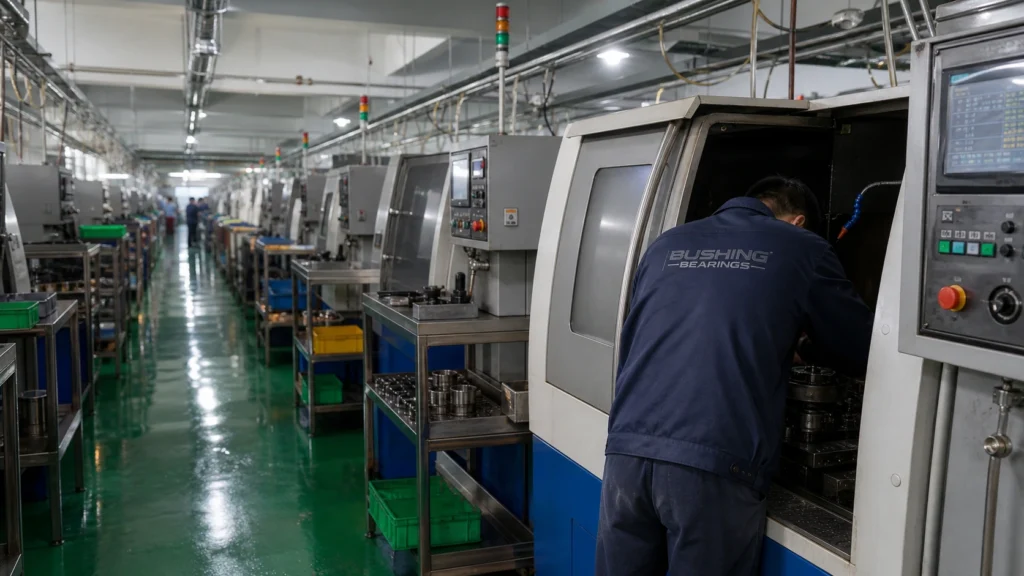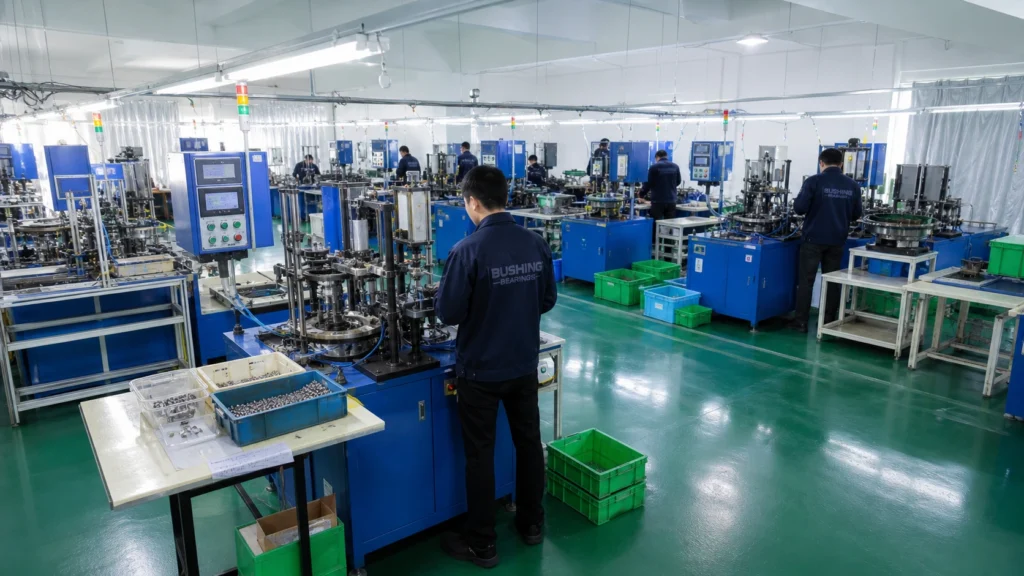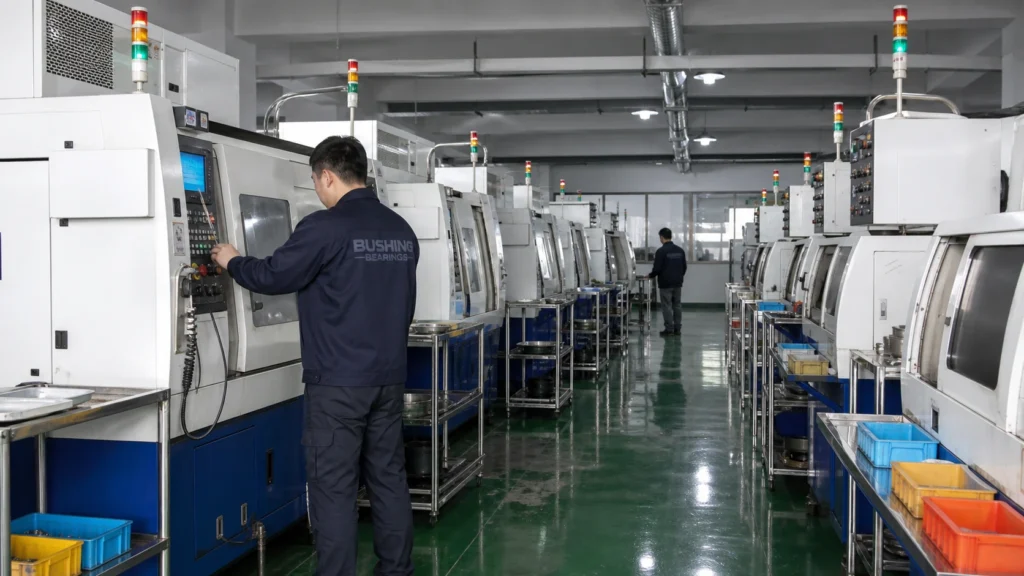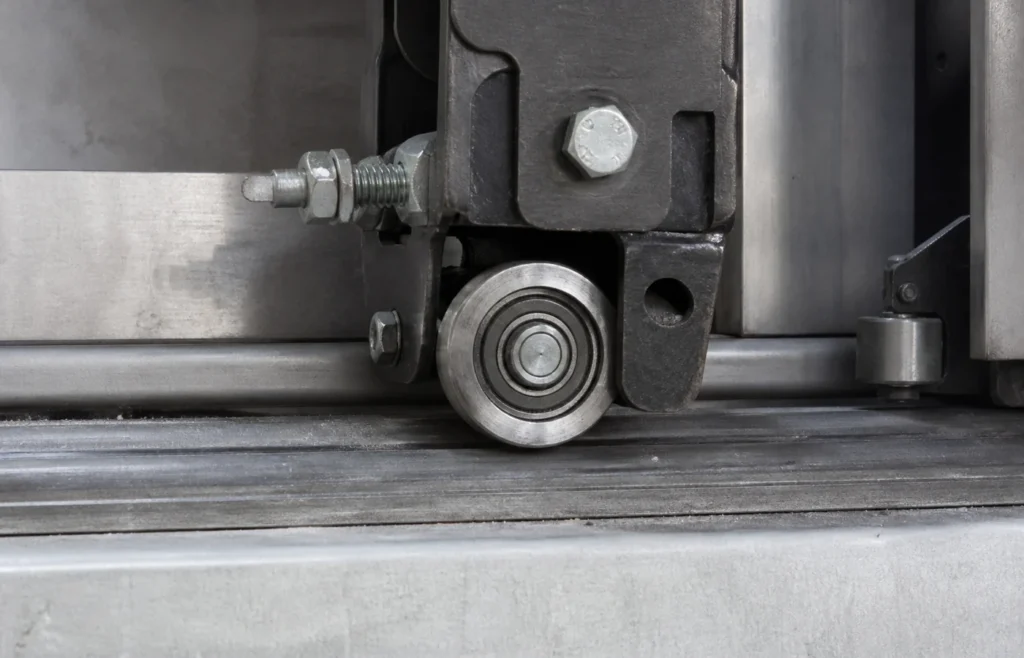
Application guide for 6000-ZZ Series Shielded Ball Bearings to ISO 15 / DIN 625-1 / GB/T 276. The core duty of the type is carrying a radial load on a rotating shaft, with incidental axial load in either direction, at the highest speed and the lowest friction of any radial rolling bearing. One row of balls in deep raceway grooves: point contact keeps friction and heat generation low, and the groove shoulders take a modest axial load in either direction without any second bearing to oppose them. The typical industries, the specification checklist, mounting practice and the exclusion cases are set out below. This series is catalogued from 10 mm to 100 mm bore; the full table of boundary dimensions is further down the page.
Typical Applications for 6000-ZZ Series Shielded Ball Bearings
The machine positions and sectors where this type is specified:
- Gearboxes: shaft positions carrying moderate radial load with the light thrust that helical gearing produces.
- Conveyor idlers and rollers: sealed bearings in wet and dusty duty, where excluding contamination decides the life rather than the load rating does.
- Appliances and power tools: high-volume, small-bore, high-speed positions where cost per unit and noise both matter.
- Agricultural and light machinery: general shaft support on drives, augers and rotors that see intermittent duty and field conditions.
- Maintenance and repair (MRO): replacing a failed bearing where the original designation, clearance group and sealing have to be matched exactly.
How to Specify 6000-ZZ Series Shielded Ball Bearings for Your Application
- Bore: Start from the bore the shaft or housing gives you — this series is catalogued from 10 mm to 100 mm — then check the outer diameter and width against the space available. The boundary dimensions are fixed by the standard, so they are the same from any manufacturer; the load ratings and limiting speeds are not, and belong to the specific bearing being supplied.
- Seal or shield: ZZ shields are non-contacting: they keep coarse dirt out and cost nothing in speed. 2RS lip seals contact the inner ring, exclude fine dust and splashed water, retain grease far better — and add drag, generate heat and lower the permissible speed. Choose the one the environment actually needs.
- Dimension series: The 6000, 6200 and 6300 series in the same bore differ in outer diameter, width and load rating. Take the heaviest series the housing envelope allows: a 6300 at a given bore carries substantially more than a 6200 and runs cooler for the same load, while the 6800 and 6900 thin sections exist for envelopes where the outer diameter is the constraint.
- Speed: Check the limiting speed for the lubrication method you intend to use. Grease-lubricated limiting speeds are lower than oil, and a contact seal lowers them again.
- Load rating and life: Use the basic dynamic rating Cr with the actual load and speed to calculate a bearing life, and the static rating C0r to check against the highest load the bearing sees standing still or at shock. Ratings vary by a few percent between manufacturers for the same designation, so calculate with the figures for the bearing you are actually buying.
- Designation and suffixes: State the complete designation including every suffix. The base number gives the type and the boundary dimensions; the suffixes carry the sealing, the cage, the clearance group, the tolerance class and any special execution — and two bearings whose base numbers match but whose suffixes differ are not interchangeable.
- Internal clearance group: State the radial internal clearance: C2 (reduced), CN (normal, and unmarked), C3, C4 or C5. Clearance is consumed after the bearing is fitted — by the interference fit on the shaft, and by the inner ring running hotter than the outer — so a bearing with a tight fit or a hot inner ring is ordered C3 and a bearing mounted lightly at even temperature is left CN. This field is left off orders more often than any other, and the bearing then arrives in the normal group by default.
- Seal or shield: State open, shielded (ZZ, 2Z) or sealed (2RS, 2RZ). A shield is non-contacting: it excludes coarse contamination and costs nothing in speed. A contact seal excludes fine dust and water and retains grease, but it rubs — it adds drag, raises the running temperature and lowers the permissible speed. Sealed bearings are also greased for life and cannot be relubricated.
- Cage material: State the cage. Pressed steel is the default and suits most duties; machined brass takes shock, high temperature and poor lubrication better and is used in large and heavily loaded bearings; polyamide is quiet, light and low-friction but has a temperature limit of about 120 °C and is attacked by aged oil. The cage is not a detail — it is the component that most often sets the real temperature limit of the bearing.
- Shaft and housing fit: Specify the seat tolerances, not just the bearing. The rule is that the ring which rotates relative to the load direction takes the interference fit: for a rotating inner ring under normal radial load the shaft seat is typically k5 or k6 with the housing bore H7, and where the outer ring rotates the interference moves to the housing (N7 or P7) with a clearance fit (g6) on the shaft. Heavier loads and hollow shafts move the fits tighter. A correctly chosen bearing in the wrong fit fails anyway — too loose and the ring creeps and frets its seat, too tight and the interference consumes the internal clearance and the bearing runs preloaded.
- Standard: Boundary dimensions are to ISO 15 / DIN 625-1 / GB/T 276. Quoting the standard on the order guarantees the mounting dimensions are interchangeable between suppliers — it does not standardize load ratings, limiting speeds or internal design, which remain manufacturer-specific.
Mounting & Assembly Practice
- Apply the mounting force to the ring that takes the interference fit, and never through the balls. Pressing on the outer ring to seat an inner-ring interference fit drives the load through the ball-raceway contacts and brinells them before the bearing has turned once.
- For interference fits above roughly 60 mm bore, heat the bearing to 80–100 °C in an induction heater or a clean oil bath and slide it on. Never heat above 120 °C: the rings are dimensionally stabilized for a temperature limit and lose hardness beyond it.
- Fill a grease-lubricated housing 30–50 percent by free volume. A completely packed housing has nowhere to churn the excess and runs hot.
- Seat the ring square against the shaft shoulder, and check the shoulder height against the chamfer r min in the table — a shoulder that fouls the chamfer never seats the ring.
Common Selection Mistakes with 6000-ZZ Series Shielded Ball Bearings
- Fitting 2RS bearings on a high-speed position because they are "better sealed", and then chasing a heat problem that the seal drag created.
- Ordering normal (CN) clearance for a bearing with an interference fit on the shaft and a hot inner ring. The fit and the temperature gradient each consume internal clearance, and the bearing runs preloaded and fails early. C3 exists for exactly that combination.
- Using a deep groove ball bearing as the thrust bearing of an assembly. It has genuine but secondary axial capacity; a sustained axial load with no radial load runs the ball contact up onto the groove shoulder.
- Specifying 2RS contact seals on a position that is already near its limiting speed, then finding the bearing runs hot for reasons unrelated to load.
Where 6000-ZZ Series Shielded Ball Bearings Are Not the Right Choice
- A 2RS contact seal adds friction and caps the speed; on a position already near its limiting speed, the seal, not the load, is what will overheat the bearing. Sealed-for-life bearings also cannot be relubricated, so they are the wrong choice wherever the grease life is shorter than the machine life.
- Not as a thrust bearing. Axial capacity is incidental to a radial load, not a rating to design against — a shaft loaded purely axially needs a thrust bearing or an angular contact pair.
- Not for misalignment. A deep groove bearing tolerates a few minutes of arc between the shaft seat and the housing bore; beyond that the ball path shifts to the edge of the groove and the bearing fails by edge loading. Use a self-aligning ball or a housed unit.
- Not for the heaviest radial load in a given envelope. Point contact concentrates the load into a small ellipse; a cylindrical or spherical roller bearing of the same boundary dimensions carries several times more.