Skip to content
info@bushingbearings.com +86 15999653684

Ball Bearings · ISO 15 / DIN 625-1 / GB/T 276 · Application guide

What Are 6000 Series Deep Groove Ball Bearings Used For?

Typical applications, the industries that specify 6000 series deep groove ball bearings in 10 mm to 100 mm bore, how to state the designation, clearance, sealing, cage and fit on an order, and where a different bearing type is the right answer.

6000 Series Deep Groove Ball Bearings are used for carrying a radial load on a rotating shaft, with incidental axial load in either direction, at the highest speed and the lowest friction of any radial rolling bearing. Boundary dimensions are to ISO 15 / DIN 625-1 / GB/T 276, and selection is driven by the radial load and the speed at the bore the shaft gives you, then by the sealing, the internal clearance and the cage that the temperature and the lubrication method require.

Primary duty
Carrying a radial load on a rotating shaft, with incidental axial load in either direction, at the highest speed and the lowest friction of any radial rolling bearing
Load direction
Radial, with incidental axial load in both directions
Bore range
10 mm to 100 mm
Boundary dimensions
ISO 15 / DIN 625-1 / GB/T 276
Category
Ball Bearings

Application notes are general engineering guidance. Basic load ratings, limiting speeds and permissible misalignment vary between manufacturers for the same designation — verify them against the catalog of the bearing actually being supplied, and against your own bearing life calculation.

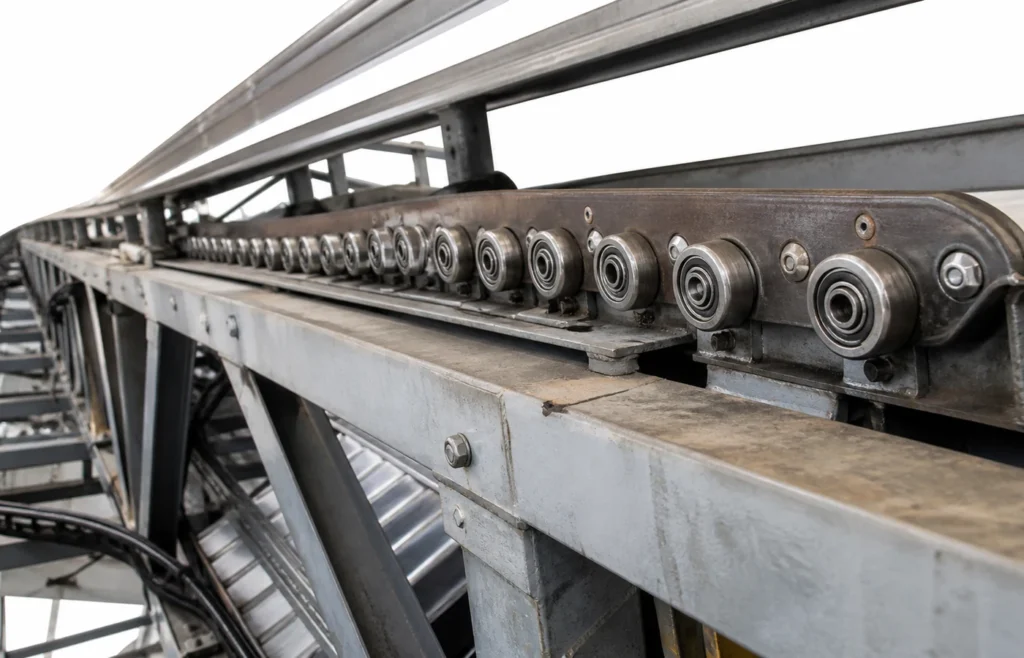
Escalator chain roller bearing — a typical application for 6000 Series Deep Groove Ball Bearings
A typical service position for 6000 Series Deep Groove Ball Bearings.

Application guide for 6000 Series Deep Groove Ball Bearings to ISO 15 / DIN 625-1 / GB/T 276. The core duty of the type is carrying a radial load on a rotating shaft, with incidental axial load in either direction, at the highest speed and the lowest friction of any radial rolling bearing. One row of balls in deep raceway grooves: point contact keeps friction and heat generation low, and the groove shoulders take a modest axial load in either direction without any second bearing to oppose them. The typical industries, the specification checklist, mounting practice and the exclusion cases are set out below. This series is catalogued from 10 mm to 100 mm bore; the full table of boundary dimensions is further down the page.

Typical Applications for 6000 Series Deep Groove Ball Bearings

The machine positions and sectors where this type is specified:

  • Fans and blowers: long-running, lightly loaded shafts on which a shielded or sealed bearing runs for years on its factory grease charge.
  • Gearboxes: shaft positions carrying moderate radial load with the light thrust that helical gearing produces.
  • Conveyor idlers and rollers: sealed bearings in wet and dusty duty, where excluding contamination decides the life rather than the load rating does.
  • Appliances and power tools: high-volume, small-bore, high-speed positions where cost per unit and noise both matter.
  • Agricultural and light machinery: general shaft support on drives, augers and rotors that see intermittent duty and field conditions.

How to Specify 6000 Series Deep Groove Ball Bearings for Your Application

  • Bore: Start from the bore the shaft or housing gives you — this series is catalogued from 10 mm to 100 mm — then check the outer diameter and width against the space available. The boundary dimensions are fixed by the standard, so they are the same from any manufacturer; the load ratings and limiting speeds are not, and belong to the specific bearing being supplied.
  • Dimension series: The 6000, 6200 and 6300 series in the same bore differ in outer diameter, width and load rating. Take the heaviest series the housing envelope allows: a 6300 at a given bore carries substantially more than a 6200 and runs cooler for the same load, while the 6800 and 6900 thin sections exist for envelopes where the outer diameter is the constraint.
  • Speed: Check the limiting speed for the lubrication method you intend to use. Grease-lubricated limiting speeds are lower than oil, and a contact seal lowers them again.
  • Load rating and life: Use the basic dynamic rating Cr with the actual load and speed to calculate a bearing life, and the static rating C0r to check against the highest load the bearing sees standing still or at shock. Ratings vary by a few percent between manufacturers for the same designation, so calculate with the figures for the bearing you are actually buying.
  • Designation and suffixes: State the complete designation including every suffix. The base number gives the type and the boundary dimensions; the suffixes carry the sealing, the cage, the clearance group, the tolerance class and any special execution — and two bearings whose base numbers match but whose suffixes differ are not interchangeable.
  • Internal clearance group: State the radial internal clearance: C2 (reduced), CN (normal, and unmarked), C3, C4 or C5. Clearance is consumed after the bearing is fitted — by the interference fit on the shaft, and by the inner ring running hotter than the outer — so a bearing with a tight fit or a hot inner ring is ordered C3 and a bearing mounted lightly at even temperature is left CN. This field is left off orders more often than any other, and the bearing then arrives in the normal group by default.
  • Seal or shield: State open, shielded (ZZ, 2Z) or sealed (2RS, 2RZ). A shield is non-contacting: it excludes coarse contamination and costs nothing in speed. A contact seal excludes fine dust and water and retains grease, but it rubs — it adds drag, raises the running temperature and lowers the permissible speed. Sealed bearings are also greased for life and cannot be relubricated.
  • Cage material: State the cage. Pressed steel is the default and suits most duties; machined brass takes shock, high temperature and poor lubrication better and is used in large and heavily loaded bearings; polyamide is quiet, light and low-friction but has a temperature limit of about 120 °C and is attacked by aged oil. The cage is not a detail — it is the component that most often sets the real temperature limit of the bearing.
  • Shaft and housing fit: Specify the seat tolerances, not just the bearing. The rule is that the ring which rotates relative to the load direction takes the interference fit: for a rotating inner ring under normal radial load the shaft seat is typically k5 or k6 with the housing bore H7, and where the outer ring rotates the interference moves to the housing (N7 or P7) with a clearance fit (g6) on the shaft. Heavier loads and hollow shafts move the fits tighter. A correctly chosen bearing in the wrong fit fails anyway — too loose and the ring creeps and frets its seat, too tight and the interference consumes the internal clearance and the bearing runs preloaded.
  • Standard: Boundary dimensions are to ISO 15 / DIN 625-1 / GB/T 276. Quoting the standard on the order guarantees the mounting dimensions are interchangeable between suppliers — it does not standardize load ratings, limiting speeds or internal design, which remain manufacturer-specific.

Mounting & Assembly Practice

  • Apply the mounting force to the ring that takes the interference fit, and never through the balls. Pressing on the outer ring to seat an inner-ring interference fit drives the load through the ball-raceway contacts and brinells them before the bearing has turned once.
  • For interference fits above roughly 60 mm bore, heat the bearing to 80–100 °C in an induction heater or a clean oil bath and slide it on. Never heat above 120 °C: the rings are dimensionally stabilized for a temperature limit and lose hardness beyond it.
  • Fill a grease-lubricated housing 30–50 percent by free volume. A completely packed housing has nowhere to churn the excess and runs hot.
  • Seat the ring square against the shaft shoulder, and check the shoulder height against the chamfer r min in the table — a shoulder that fouls the chamfer never seats the ring.

Common Selection Mistakes with 6000 Series Deep Groove Ball Bearings

  • Ordering normal (CN) clearance for a bearing with an interference fit on the shaft and a hot inner ring. The fit and the temperature gradient each consume internal clearance, and the bearing runs preloaded and fails early. C3 exists for exactly that combination.
  • Using a deep groove ball bearing as the thrust bearing of an assembly. It has genuine but secondary axial capacity; a sustained axial load with no radial load runs the ball contact up onto the groove shoulder.
  • Specifying 2RS contact seals on a position that is already near its limiting speed, then finding the bearing runs hot for reasons unrelated to load.

Where 6000 Series Deep Groove Ball Bearings Are Not the Right Choice

  • Not as a thrust bearing. Axial capacity is incidental to a radial load, not a rating to design against — a shaft loaded purely axially needs a thrust bearing or an angular contact pair.
  • Not for misalignment. A deep groove bearing tolerates a few minutes of arc between the shaft seat and the housing bore; beyond that the ball path shifts to the edge of the groove and the bearing fails by edge loading. Use a self-aligning ball or a housed unit.
  • Not for the heaviest radial load in a given envelope. Point contact concentrates the load into a small ellipse; a cylindrical or spherical roller bearing of the same boundary dimensions carries several times more.

Water bottle capping line bearing — a typical application for 6000 Series Deep Groove Ball Bearings
Another position where 6000 Series Deep Groove Ball Bearings are specified.

Technical Drawing

Customize the parameters below — every spec field is editable, and the drawing redraws to match the values you choose. Changing the designation snaps the other fields to that size's standard values; you can then override any individual value.

Sends the selected values to the quote form below.

Request a Quote

The form below follows the current technical drawing configuration. Change the drawing values above and the request details update automatically.

Request a Quotation

Specification
Business Information
Our facility

Who makes the bearing behind this application

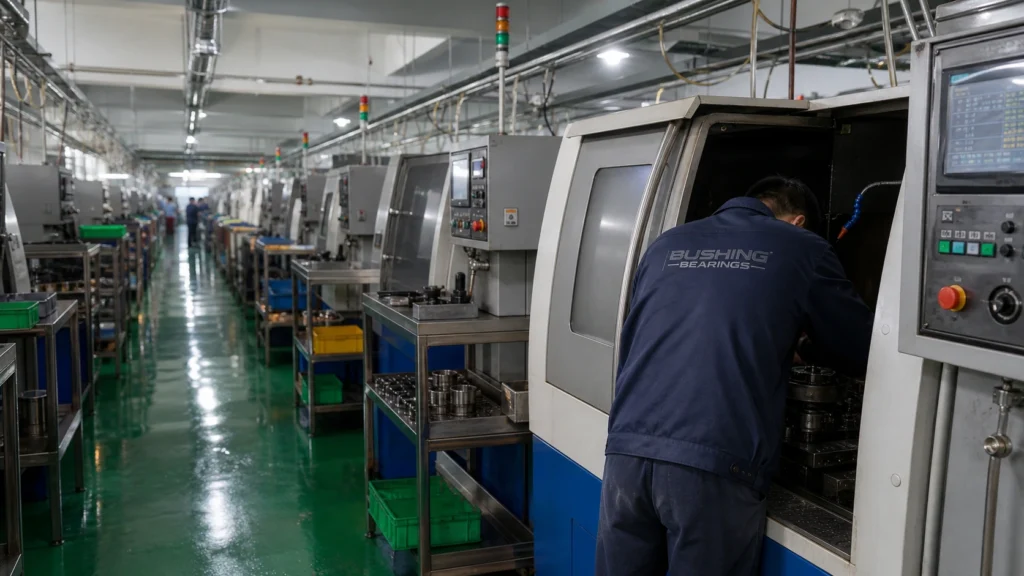
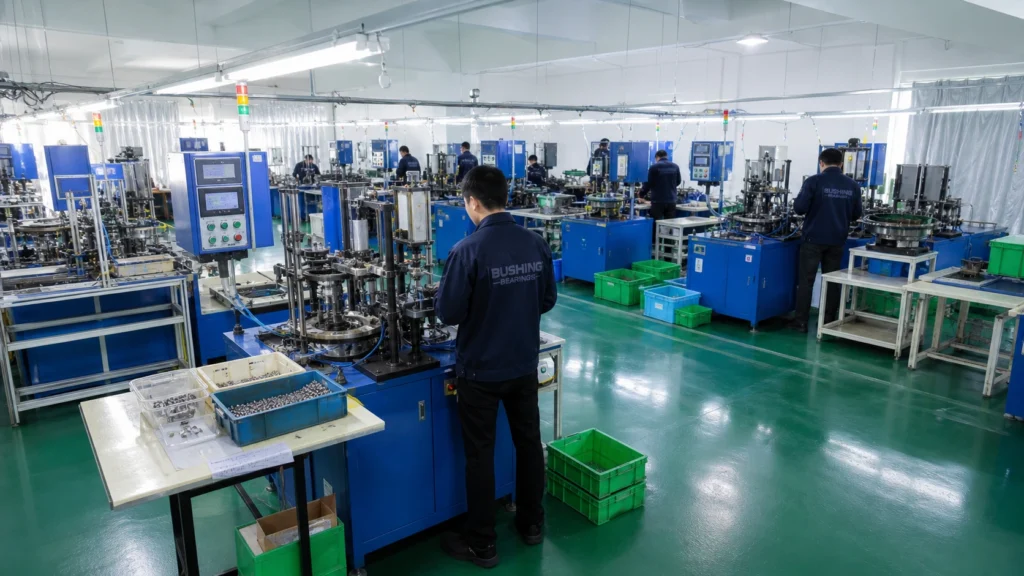
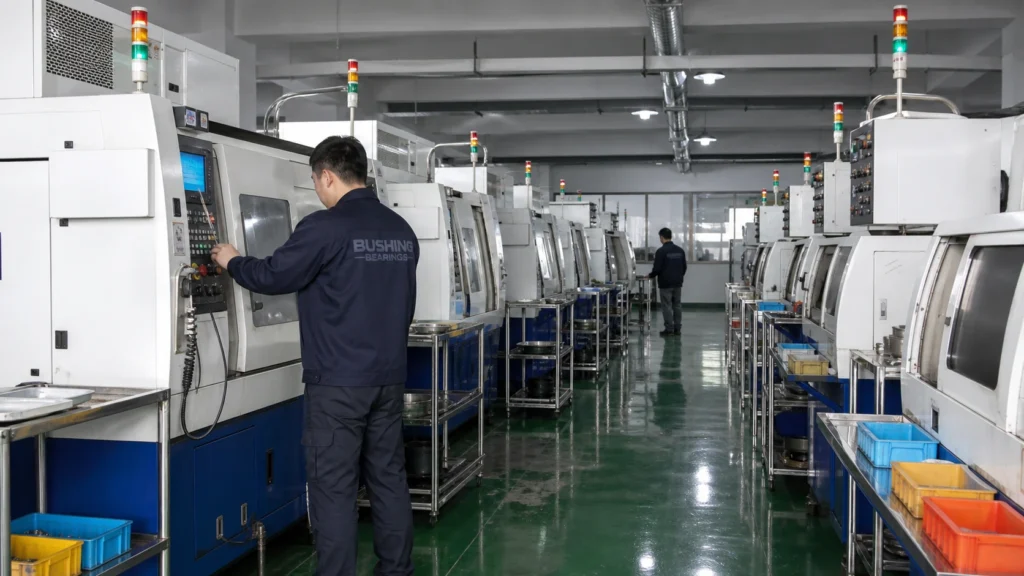
These are not resold from stock. Rings are forged and hardened here, raceways ground and superfinished here, and clearance set against the group you order — which is what makes a run repeatable a year later.

Bearing production line, wide view
Ring inspection station
Bearing assembly and clearance setting
Finished bearings staged for packing

Dimensions & Specifications (ISO 15 / DIN 625-1 / GB/T 276)

DesignationBore d (mm)Outer diameter D (mm)Width B (mm)Chamfer r min (mm)Basic dynamic load rating Cr (kN)Basic static load rating C0r (kN)Limiting speed grease (rpm)Mass (kg)
6000102680.34.751.96200000.019
6001122880.35.42.36190000.021
6002153290.35.852.85170000.030
60031735100.36.053.25150000.039
60042042120.69.955.0130000.069
60052547120.611.96.55110000.078
6006305513113.88.395000.116
6007356214116.810.285000.153
6008406815117.811.680000.185
6009457516122.114.670000.235
6010508016122.916.067000.261
60115590181.130.721.260000.393
60126095181.130.723.256000.417
601365100181.132.525.053000.440
601470110201.139.731.050000.616
601575115201.141.633.545000.650
601680125221.147.539.043000.870
601785130221.149.441.540000.910
601890140241.560.550.038001.20
601995145241.563.754.036001.25
6020100150241.560.554.034001.30

Video: What Are 6000 Series Deep Groove Ball Bearings Used For? in use

Third-party video, selected automatically for this topic. It is not produced by Bushing Bearings and is not a specification source — use the tables on this page for dimensional data.

Inside the plant

Manufactured in our own plant

This bearing is forged, hardened, ground, superfinished and clearance-set in-house. The stages below are where its tolerance class, its internal clearance and its noise grade are actually decided.

  1. Bearing ring blanks coming off the forging press
    01

    Forging & turning

    GCr15 bar and tube is cut, heated and forged into ring blanks, then turned to leave a uniform grinding allowance. Forging rather than machining from solid keeps the grain flow following the raceway, which is the surface that eventually fails.

    Blank dimensions and grinding stock checked at set-up and per shift.

  2. Bearing rings entering a continuous hardening furnace
    02

    Heat treatment

    Through-hardening brings GCr15 / 100Cr6 to 58–64 HRC; carburizing case-hardens 20CrMnTi where the section is heavy or the load is shock. Rings are then stabilized so they hold size in service rather than growing in the housing.

    Core and surface hardness per lot; retained austenite and dimensional stability to the ordered temperature class.

  3. Raceway grinding machine finishing a bearing inner ring
    03

    Raceway grinding

    Faces, bore, outer diameter and raceway are ground in sequence on separate machines. This is where the tolerance class is created: P0, P6, P5 or P4 is a grinding outcome, not a sorting outcome.

    Bore and outer diameter deviation, raceway roundness and face runout measured to ISO 492 on every setup.

  4. Superfinishing stones acting on a ground raceway
    04

    Honing & superfinishing

    The ground raceway is honed to remove the grinding lay and bring surface roughness down to a fraction of a micrometre. Raceway finish is what decides whether a lubricant film forms, and therefore what decides bearing life far more than the load rating alone.

    Surface roughness Ra and waviness measured per lot.

Frequently Asked Questions

What is the difference between ZZ and 2RS?

ZZ is a pair of non-contacting steel shields: they keep coarse contamination out and add no measurable friction, so the limiting speed is unchanged. 2RS is a pair of contacting rubber lip seals: they exclude fine dust and splashed water and retain grease far better, but the lips rub, so they add drag, generate heat and reduce the permissible speed.

Do I need C3 internal clearance?

C3 is the answer when clearance will be consumed after mounting — a heavy interference fit on the shaft, a hot inner ring relative to the housing, or both. For a normally fitted bearing at ambient temperature, CN (the unmarked normal group) is correct, and specifying C3 there simply leaves the bearing running with more clearance and more noise than intended.

How do I choose the right size of 6000 Series Deep Groove Ball Bearings?

Start from the bore the shaft or housing gives you — this series is catalogued from 10 mm to 100 mm — then check the outer diameter and the width against the space available, and confirm the calculated life against the load and speed. The full table of boundary dimensions is on this page.

What has to be stated when ordering 6000 Series Deep Groove Ball Bearings?

The complete designation with every suffix, the internal clearance group or preload class, the seal or shield type, and the cage material — plus the shaft and housing seat tolerances on the drawing. The bearing and the fit are one specification: a correctly chosen bearing in the wrong fit either creeps on its seat or runs preloaded.

Can I get a quote for 6000 Series Deep Groove Ball Bearings in the size and specification I need?

Yes. Use the technical drawing and quote form on this page to set the size and options, then send the exact configuration — designation, clearance, sealing and cage — to our team for pricing and lead time.