
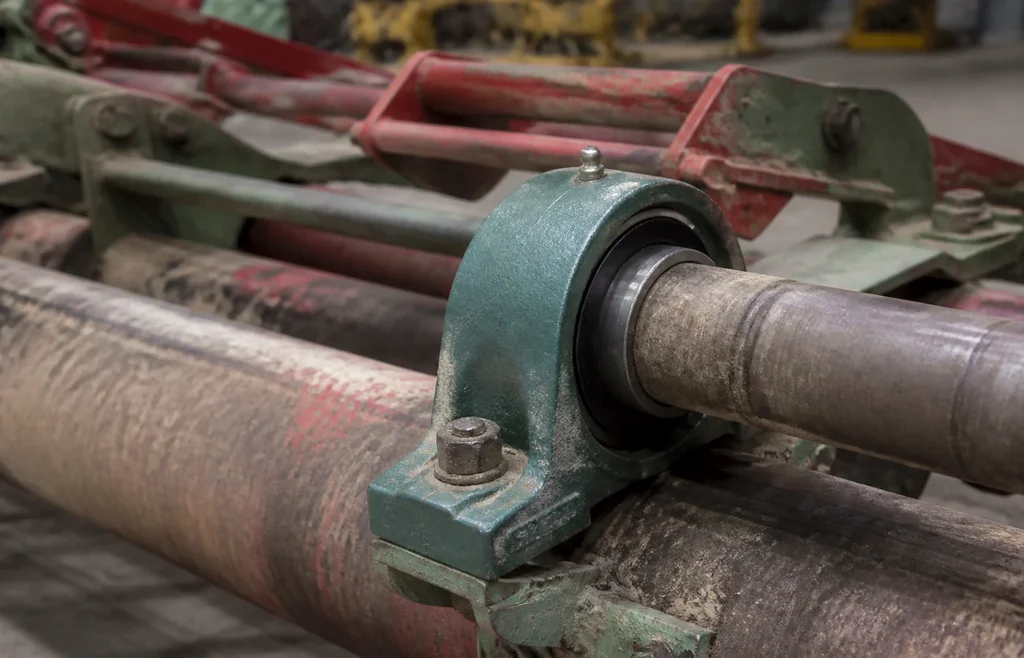
The 70 mm bore of the GE ES-2RS Series Sealed Spherical Plain Bearings is the GE70ES-2RS: 70 mm bore, 105 mm outside diameter, 49 mm wide. This page gives the dimensional row from the table, the shaft and housing fits that suit it, the internal clearance to expect and the mounting, lubrication and failure notes that go with the type.
70 mm Bore Dimensional Row (DIN ISO 12240-1 series K / DIN 648 series E)
| Designation | Bore d (mm) | Outer diameter D (mm) | Width B (mm) | Inner ring width C (mm) |
|---|---|---|---|---|
| GE70ES-2RS | 70 | 105 | 49 | 40 |
What a GE ES-2RS Series Sealed Spherical Plain Bearings Does
A spherical plain bearing has no rolling elements: a spherically ground inner ring slides in a matching outer ring. It carries very high load through a slow, oscillating or intermittent movement, and swivels through several degrees — the duty that would destroy a rolling bearing in weeks.
Primarily radial load, with a limited axial capacity in both directions. Treat the axial figure as a secondary rating, not as a thrust rating.
Speed at 70 mm Bore
A sliding bearing is not rated in rev/min. Its limit is a pv value — the product of contact pressure and sliding velocity — because it is the heat generated at the sliding surface, not a rotational speed, that ends its life. Continuous rotation at any speed is the duty most likely to exceed it.
Shaft & Housing Fit for a 70 mm Seat
With the inner ring rotating under a load whose direction is fixed, the inner ring sees a circumferential load and must be an interference fit, or it will creep on the shaft and fret it. The outer ring sees a point load and takes a transition or clearance fit so that it can shift slowly and spread the wear — and so that one of the two bearings on the shaft is free to take up axial expansion.
| Shaft, light load (P ≤ 0.06 C) | j6 |
|---|---|
| Shaft, normal load (P = 0.06–0.12 C) | k5 or k6 |
| Shaft, heavy or shock load (P > 0.12 C) | n6 |
| Housing — Axial displacement of the outer ring required | H7 |
| Housing — Normal load, outer ring may still shift | J7 |
| Housing — Normal to heavy load, quiet running, outer ring not displaceable | K7 |
ISO 286-2 tolerance grades, applied per the conventional bearing seat recommendations of ISO 1132-2 and DIN 5425-1, for a SOLID STEEL shaft in a cast iron or steel housing. A hollow shaft, a thin-walled housing or a light alloy housing needs a tighter fit than these, because the seat itself deflects.
Mounting a 70 mm Bore GE ES-2RS Series Sealed Spherical Plain Bearings
The ring that carries the rotating load takes an interference fit; the ring under a stationary point load takes a transition or clearance fit so that it can creep slowly and spread the wear, and so that one ring is free to take up axial expansion. With a rotating shaft under a fixed load direction, that means an interference fit on the shaft and a looser fit in the housing. Press only against the ring being fitted — force driven through the rolling elements leaves brinell marks in the raceway before the bearing has run a revolution.
At a 70 mm bore the interference is small enough that a cold press or a light hydraulic press is normally enough; heating the bearing in an induction heater or an oil bath to 80–100 °C above the shaft is the alternative, and never above 120 °C for a standard-stabilized bearing. Keep the heated bearing pressed against the shoulder while it cools, because it shrinks axially as well as radially.
Lubrication & Relubrication
This bearing is designed to run without added lubricant: the sliding layer carries its own solid lubricant, transferring a thin film onto the mating surface during the first movements. Do not grease it in the expectation of longer life — grease is not needed, it can wash the transfer film away, and it gives dust something to stick to. Where the duty genuinely needs a lubricant, a steel-on-steel version that is designed to be regreased is the correct part, not a greased maintenance-free one.
Sealed-for-life versions carry their whole service life of grease inside the seals and cannot be relubricated. That is the right choice where the bearing is inaccessible and the duty is mild; it is the wrong one where the temperature is high, the environment is wet, or the required life is longer than the grease life — and the grease, not the steel, is what ends it.
Failure Modes and What They Look Like
- Wear-through of the sliding layer — the liner thins until the backing shows through, and the joint develops play. It is the normal end of life for a maintenance-free bearing and is diagnosed by measuring the radial play, not by listening to it.
- Abrasive wear — scoring lines around the bore and embedded grit in the softer surface. A sliding bearing tolerates dirt better than a rolling one, but it still grinds itself away on it — seal the joint or accept a shorter interval.
- Edge loading — wear concentrated at one end of the bore. On a cylindrical bushing it means the shaft is misaligned or deflecting, and it is the reason the spherical plain bearing exists as a separate product.
- Overheating from excessive pv — discolouration, softening or melting of the liner, and rapid loss of the bore. The bearing was run too fast for its contact pressure, or continuously where it was chosen for oscillation.
Where NOT to Use a GE ES-2RS Series Sealed Spherical Plain Bearings
- Do not use a spherical plain bearing for continuous rotation. It is designed for slow, oscillating or intermittent movement, and continuous rotation drives the sliding surface past its pv limit and overheats the liner.
- Do not grease a maintenance-free bearing. The PTFE liner works by transferring a film onto the mating surface; grease interferes with that and traps abrasive dust in the joint.
- Do not run one on a worn or undersized pin. All the load passes through the contact between the pin and the bore, and a loose pin converts a sliding load into an impact load.
- Do not treat a sealed bearing as sealed for life in a wet or hot environment. A contact seal has a temperature and a pressure limit of its own, and once it is past them the grease leaves and the water arrives.
Stepping Up or Down from 70 mm
Within the same series, the next bore up in this series is 80 mm and the next bore down is 60 mm. Changing bore changes the shaft, so it is the last thing to change: when the calculated life at 70 mm is short, the first move is to a heavier diameter series at the SAME bore — the 6300 envelope instead of the 6200, for instance — which raises the rating without touching the shaft. The second is to change type: a roller bearing carries far more radial load than a ball bearing of the same envelope.



