
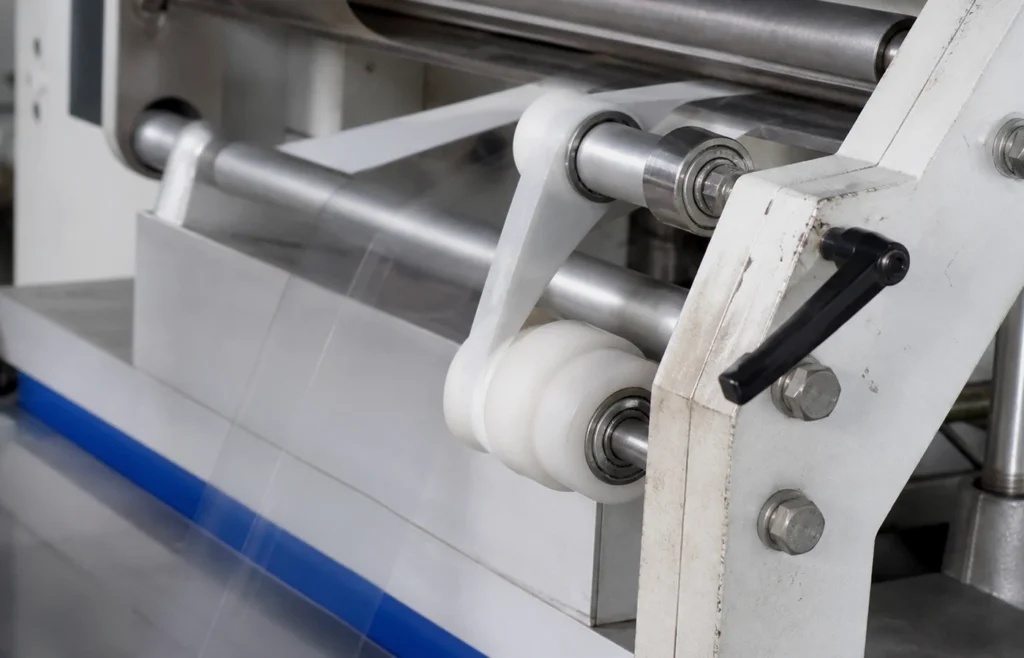
Dimensional and installation data for the 30 mm bore size of NA49 Series Machined Ring Needle Roller Bearings, dimensioned to ISO 1206 / DIN 617 / GB/T 5801. Selection is by bore diameter — the bearing designation is what the shaft is machined to — so the figures below start with the boundary dimensions and go on to the fits, the clearance and the mounting method that make them work.
30 mm Bore Dimensional Row (ISO 1206 / DIN 617 / GB/T 5801)
| Designation | Bore d (mm) | Outer diameter D (mm) | Width B (mm) |
|---|---|---|---|
| NA4906 | 30 | 47 | 17 |
What a NA49 Series Machined Ring Needle Roller Bearings Does
Needle rollers have a length several times their diameter, so a large number of them fit into a very small radial section. This is the type to reach for when the shaft diameter is fixed, the radial load is high and there is almost no room between the shaft and the housing bore.
Radial load. Axial load has to be carried by another element in the assembly.
Speed at 30 mm Bore
No limiting speed is tabulated for this product. Where speed matters, the figure to work to is the one the bearing supplier states for the exact design, cage and lubricant supplied — not a family value.
Shaft & Housing Fit for a 30 mm Seat
With the inner ring rotating under a load whose direction is fixed, the inner ring sees a circumferential load and must be an interference fit, or it will creep on the shaft and fret it. The outer ring sees a point load and takes a transition or clearance fit so that it can shift slowly and spread the wear — and so that one of the two bearings on the shaft is free to take up axial expansion.
| Shaft, light load (P ≤ 0.06 C) | j6 |
|---|---|
| Shaft, normal load (P = 0.06–0.12 C) | k5 or k6 |
| Housing — Axial displacement of the outer ring required | H7 |
| Housing — Normal load, outer ring may still shift | J7 |
| Housing — Normal to heavy load, quiet running, outer ring not displaceable | K7 |
ISO 286-2 tolerance grades, applied per the conventional bearing seat recommendations of ISO 1132-2 and DIN 5425-1, for a SOLID STEEL shaft in a cast iron or steel housing. A hollow shaft, a thin-walled housing or a light alloy housing needs a tighter fit than these, because the seat itself deflects.
Mounting a 30 mm Bore NA49 Series Machined Ring Needle Roller Bearings
The ring that carries the rotating load takes an interference fit; the ring under a stationary point load takes a transition or clearance fit so that it can creep slowly and spread the wear, and so that one ring is free to take up axial expansion. With a rotating shaft under a fixed load direction, that means an interference fit on the shaft and a looser fit in the housing. Press only against the ring being fitted — force driven through the rolling elements leaves brinell marks in the raceway before the bearing has run a revolution.
At a 30 mm bore the interference is small enough that a cold press or a light hydraulic press is normally enough; heating the bearing in an induction heater or an oil bath to 80–100 °C above the shaft is the alternative, and never above 120 °C for a standard-stabilized bearing. Keep the heated bearing pressed against the shoulder while it cools, because it shrinks axially as well as radially.
This bearing is separable, which makes mounting easier and mis-mounting easier too: fit each ring to its own seat separately, and do not let the two halves be swapped between bearings once they have run — the raceways wear as a matched pair.
Lubrication & Relubrication
Grease is the normal lubricant for this type: it stays where it is put, helps to keep contamination out, and needs no circulation system. Fill roughly 30% to 50% of the free space in the bearing arrangement — a bearing packed full runs hot, because the excess grease is churned rather than used. The relubrication interval is not a fixed figure; it falls with speed, with temperature and with load, and it halves for roughly every 15 °C of temperature rise above about 70 °C. Where speed, temperature or the required interval put grease out of reach, change to oil.
Failure Modes and What They Look Like
- Subsurface fatigue (spalling) — a flake of raceway lifts out and the bearing gets noisy and rough. This is the failure the L10 life calculation predicts — if it arrives near the calculated life the bearing did its job, and if it arrives early the load, the fit or the lubrication was not what the calculation assumed.
- Inadequate lubrication — a polished, then discoloured, then torn raceway, running hot with a darkened grease. It is the most common cause of early failure by a wide margin, and the interval, not the grease, is usually what was wrong.
- Contamination — dents in the raceway with raised edges, then premature spalling from those dents. Wear particles, casting sand and washdown water all do it; sealing and filtration are what prevent it.
- False brinelling and fretting — evenly spaced dull marks at ball or roller pitch, produced by vibration while the shaft is stationary — a machine that travels on a truck, or a standby pump beside a running one. It is not caused by overload and cannot be cured by fitting a bigger bearing.
- Edge loading at the roller ends — wear or spalling concentrated in a band at one end of the roller path. It means misalignment or deflection: line contact has no tolerance for angular error, which is what the crowned profile can only partly correct.
Where NOT to Use a NA49 Series Machined Ring Needle Roller Bearings
- Do not run a drawn cup needle bearing directly on a soft shaft. Without an inner ring the shaft is the raceway, and it needs the same hardness and surface finish a bearing ring would have.
- Do not press a drawn cup on its face or its edge. The thin pressed outer ring distorts and the rollers bind; it is fitted with a mandrel that supports the whole ring end.
- Do not ask a needle bearing for axial location. It carries pure radial load and nothing else.
Stepping Up or Down from 30 mm
Within the same series, the next bore up in this series is 35 mm and the next bore down is 25 mm. Changing bore changes the shaft, so it is the last thing to change: when the calculated life at 30 mm is short, the first move is to a heavier diameter series at the SAME bore — the 6300 envelope instead of the 6200, for instance — which raises the rating without touching the shaft. The second is to change type: a roller bearing carries far more radial load than a ball bearing of the same envelope.



