
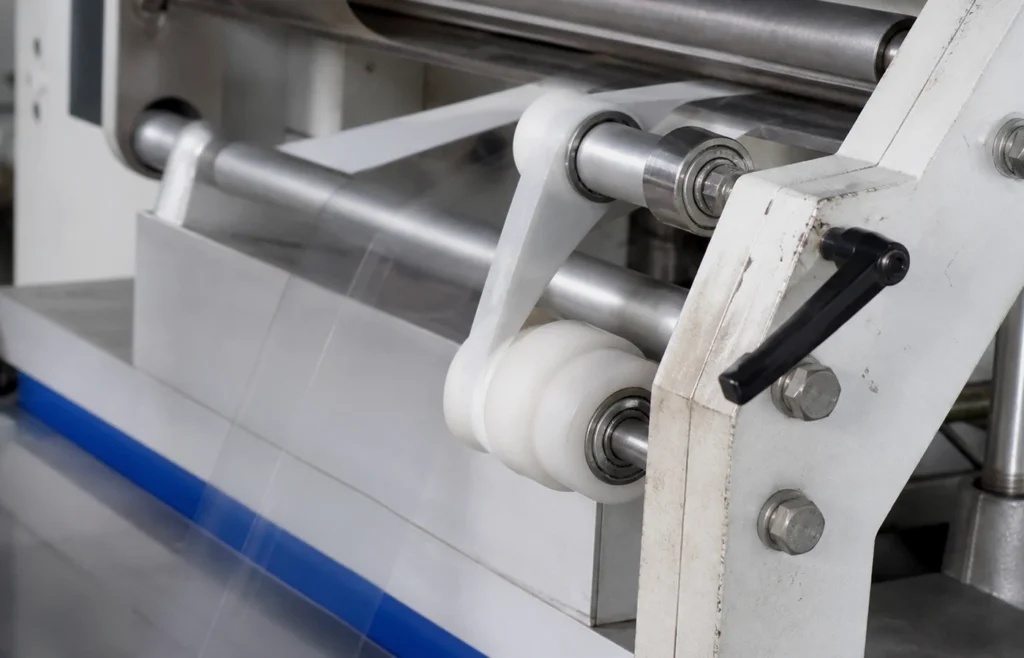
This page covers the 10 mm bore size of NATR Series Yoke Type Support Rollers to DIN 5429 / ISO 1206. It reproduces the dimensional row, then works outward from it: the fit for the load case, the internal clearance group, the shoulder and fillet the corner radius allows, and where this bearing type should and should not be used.
10 mm Bore Dimensional Row (DIN 5429 / ISO 1206)
| Designation | Bore d (mm) | Outer diameter D (mm) | Width C (mm) |
|---|---|---|---|
| NATR10 | 10 | 30 | 15 |
What a NATR Series Yoke Type Support Rollers Does
A track roller is a thick-walled outer ring running on needle or cylindrical rollers, carried on a stud or on its own bore. It is built to run directly on a track, a cam or a plate, so the outer ring is dimensioned for the bending that contact produces rather than for a housing seat.
Radial load. Axial load has to be carried by another element in the assembly.
Speed at 10 mm Bore
No limiting speed is tabulated for this product. Where speed matters, the figure to work to is the one the bearing supplier states for the exact design, cage and lubricant supplied — not a family value.
Mounting a 10 mm Bore NATR Series Yoke Type Support Rollers
This part is bolted or screwed into its structure rather than pressed into a housing bore, so there is no interference fit to calculate. What matters instead is that the mating faces are square and rigid, that the fixing is locked against the vibration the joint will see, and that the pin or stud through the bore is the correct diameter — a worn pin turns a sliding contact into a hammering one.
Lubrication & Relubrication
Grease is the normal lubricant for this type: it stays where it is put, helps to keep contamination out, and needs no circulation system. Fill roughly 30% to 50% of the free space in the bearing arrangement — a bearing packed full runs hot, because the excess grease is churned rather than used. The relubrication interval is not a fixed figure; it falls with speed, with temperature and with load, and it halves for roughly every 15 °C of temperature rise above about 70 °C. Where speed, temperature or the required interval put grease out of reach, change to oil.
Failure Modes and What They Look Like
- Subsurface fatigue (spalling) — a flake of raceway lifts out and the bearing gets noisy and rough. This is the failure the L10 life calculation predicts — if it arrives near the calculated life the bearing did its job, and if it arrives early the load, the fit or the lubrication was not what the calculation assumed.
- Inadequate lubrication — a polished, then discoloured, then torn raceway, running hot with a darkened grease. It is the most common cause of early failure by a wide margin, and the interval, not the grease, is usually what was wrong.
- Contamination — dents in the raceway with raised edges, then premature spalling from those dents. Wear particles, casting sand and washdown water all do it; sealing and filtration are what prevent it.
- False brinelling and fretting — evenly spaced dull marks at ball or roller pitch, produced by vibration while the shaft is stationary — a machine that travels on a truck, or a standby pump beside a running one. It is not caused by overload and cannot be cured by fitting a bigger bearing.
- Edge loading at the roller ends — wear or spalling concentrated in a band at one end of the roller path. It means misalignment or deflection: line contact has no tolerance for angular error, which is what the crowned profile can only partly correct.
Where NOT to Use a NATR Series Yoke Type Support Rollers
- Do not run a drawn cup needle bearing directly on a soft shaft. Without an inner ring the shaft is the raceway, and it needs the same hardness and surface finish a bearing ring would have.
- Do not press a drawn cup on its face or its edge. The thin pressed outer ring distorts and the rollers bind; it is fitted with a mandrel that supports the whole ring end.
- Do not ask a needle bearing for axial location. It carries pure radial load and nothing else.
Stepping Up or Down from 10 mm
Within the same series, the next bore up in this series is 12 mm and the next bore down is 8 mm. Changing bore changes the shaft, so it is the last thing to change: when the calculated life at 10 mm is short, the first move is to a heavier diameter series at the SAME bore — the 6300 envelope instead of the 6200, for instance — which raises the rating without touching the shaft. The second is to change type: a roller bearing carries far more radial load than a ball bearing of the same envelope.



