
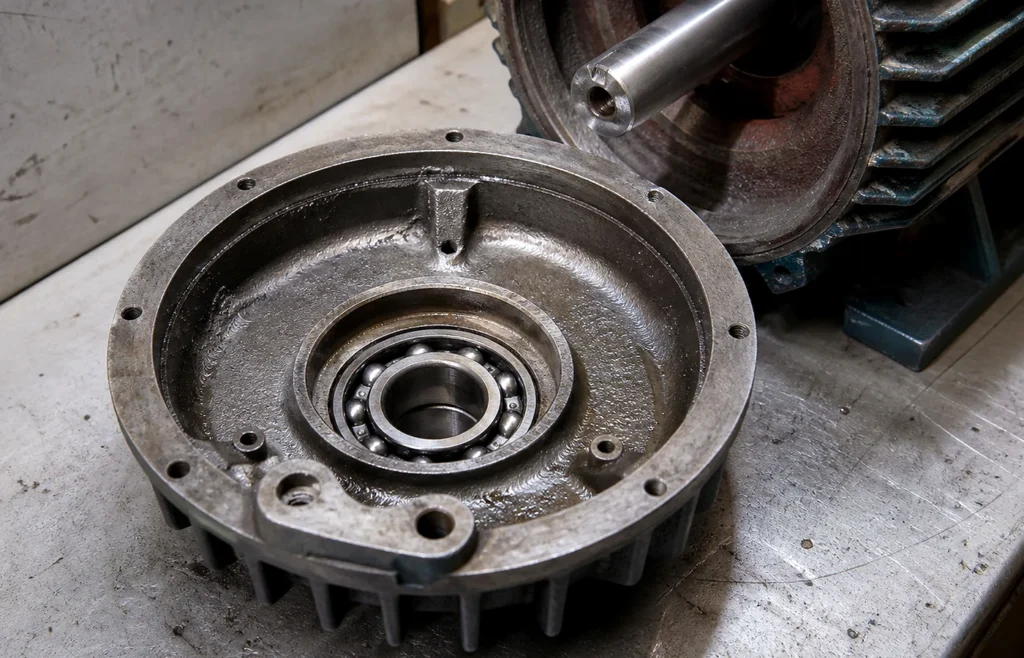
In a 6000-2rs series sealed ball bearings, Polyamide Cage is the cage, which spaces the rolling elements and keeps them from touching each other. The grade is glass-fiber reinforced PA66, injection molded as a one-piece snap cage (suffix TVP / TVH depending on the maker); it is non-magnetic, and its usable service range is continuous service to about +120 °C — above that the polyamide ages rapidly, and it is the cage rather than the steel that ends the bearing. This page covers what the material changes about the bearing, the limits it brings with it, and the sizes supplied.
Why Polyamide Cage for 6000-2RS Series Sealed Ball Bearings
Light, quiet and low friction, and it survives momentary misalignment and starved starts better than a steel cage; it is also the reason a polyamide-caged bearing cannot be run to the temperature limit of its own rings. In a 6000-2rs series sealed ball bearings it is the cage, which spaces the rolling elements and keeps them from touching each other.
A moulded polyamide cage is light, quiet and forgiving: it runs with less friction than a steel cage, tolerates momentary misalignment and shock, and survives a starved start that would let a steel cage wear. Its price is a temperature ceiling well below the rings'.
Material Properties
| Grade designation | glass-fiber reinforced PA66, injection molded as a one-piece snap cage (suffix TVP / TVH depending on the maker) |
|---|---|
| Magnetic response | Non-magnetic |
| Service temperature | Continuous service to about +120 °C — above that the polyamide ages rapidly, and it is the cage rather than the steel that ends the bearing |
| Corrosion characteristic | Unaffected by ordinary mineral greases and oils; aged prematurely by some synthetic oils and by aggressive EP additives at temperature |
Service Limits
Temperature is the limit, and it is a limit on the BEARING, not just on the cage: about +120 °C continuous, with the polyamide aging rapidly above that, especially in the presence of an oil with aggressive EP additives. A bearing that runs at 130 °C should not be ordered with a polyamide cage even though its rings would be perfectly content there.
Alternatives and When to Switch
Pressed steel is the alternative for ordinary duty at temperature; machined brass for high speed, heavy shock, and for lubricants that would age a polymer cage.
Fitting a Steel Bearing in an Aluminum Housing
Aluminum has roughly twice the coefficient of thermal expansion of bearing steel, so a housing bore machined to a normal H7 fit at room temperature grows away from the outer ring as the machine reaches operating temperature. The outer ring then turns in its seat and wears the bore. Where the housing is aluminum and the temperature rise is more than about 30 degrees C, tighten the housing fit by one grade — J7 or K7 in place of H7 — or fit a steel sleeve into the aluminum. Check the resulting internal clearance: a tighter housing fit takes clearance out of the bearing, which is often why C3 is specified alongside it.
Sizes of 6000-2RS Series Sealed Ball Bearings Available in Polyamide Cage
| Designation | Bore d (mm) | Outer diameter D (mm) | Width B (mm) | Chamfer r min (mm) | Seal type | Operating temperature range (u00b0C) | Basic dynamic load rating Cr (kN) | Basic static load rating C0r (kN) |
|---|---|---|---|---|---|---|---|---|
| 6000-2RS | 10 | 26 | 8 | 0.3 | Contact rubber seal, both sides | -30 to +110 | 4.75 | 1.96 |
| 6001-2RS | 12 | 28 | 8 | 0.3 | Contact rubber seal, both sides | -30 to +110 | 5.4 | 2.36 |
| 6002-2RS | 15 | 32 | 9 | 0.3 | Contact rubber seal, both sides | -30 to +110 | 5.85 | 2.85 |
| 6003-2RS | 17 | 35 | 10 | 0.3 | Contact rubber seal, both sides | -30 to +110 | 6.05 | 3.25 |
| 6004-2RS | 20 | 42 | 12 | 0.6 | Contact rubber seal, both sides | -30 to +110 | 9.95 | 5.0 |
| 6005-2RS | 25 | 47 | 12 | 0.6 | Contact rubber seal, both sides | -30 to +110 | 11.9 | 6.55 |
| 6006-2RS | 30 | 55 | 13 | 1 | Contact rubber seal, both sides | -30 to +110 | 13.8 | 8.3 |
| 6007-2RS | 35 | 62 | 14 | 1 | Contact rubber seal, both sides | -30 to +110 | 16.8 | 10.2 |
| 6008-2RS | 40 | 68 | 15 | 1 | Contact rubber seal, both sides | -30 to +110 | 17.8 | 11.6 |
| 6009-2RS | 45 | 75 | 16 | 1 | Contact rubber seal, both sides | -30 to +110 | 22.1 | 14.6 |
| 6010-2RS | 50 | 80 | 16 | 1 | Contact rubber seal, both sides | -30 to +110 | 22.9 | 16.0 |
| 6011-2RS | 55 | 90 | 18 | 1.1 | Contact rubber seal, both sides | -30 to +110 | 30.7 | 21.2 |
| 6012-2RS | 60 | 95 | 18 | 1.1 | Contact rubber seal, both sides | -30 to +110 | 30.7 | 23.2 |
| 6013-2RS | 65 | 100 | 18 | 1.1 | Contact rubber seal, both sides | -30 to +110 | 32.5 | 25.0 |
| 6014-2RS | 70 | 110 | 20 | 1.1 | Contact rubber seal, both sides | -30 to +110 | 39.7 | 31.0 |
| 6015-2RS | 75 | 115 | 20 | 1.1 | Contact rubber seal, both sides | -30 to +110 | 41.6 | 33.5 |
| 6016-2RS | 80 | 125 | 22 | 1.1 | Contact rubber seal, both sides | -30 to +110 | 47.5 | 39.0 |
| 6017-2RS | 85 | 130 | 22 | 1.1 | Contact rubber seal, both sides | -30 to +110 | 49.4 | 41.5 |
| 6018-2RS | 90 | 140 | 24 | 1.5 | Contact rubber seal, both sides | -30 to +110 | 60.5 | 50.0 |
| 6019-2RS | 95 | 145 | 24 | 1.5 | Contact rubber seal, both sides | -30 to +110 | 63.7 | 54.0 |
| 6020-2RS | 100 | 150 | 24 | 1.5 | Contact rubber seal, both sides | -30 to +110 | 60.5 | 54.0 |



