Bearing Accessories · DIN 3760 / ISO 6194-1 · Application guide
What Are TC Series Double Lip Shaft Seals Used For?
Typical applications, the industries that specify tc series double lip shaft seals in 22 mm to 125 mm bore, how to state the designation, clearance, sealing, cage and fit on an order, and where a different bearing type is the right answer.
TC Series Double Lip Shaft Seals are used for sealing the point where a shaft leaves a housing — keeping the lubricant in and dirt, water and dust out of the bearing behind it. Boundary dimensions are to DIN 3760 / ISO 6194-1, and selection is driven by the shaft diameter, the housing bore and the width, then by the lip arrangement and the elastomer, which set the temperature, speed and chemical limits.
Primary duty
Sealing the point where a shaft leaves a housing — keeping the lubricant in and dirt, water and dust out of the bearing behind it
Load direction
Carries no bearing load; a sealing interface only
Bore range
22 mm to 125 mm
Boundary dimensions
DIN 3760 / ISO 6194-1
Category
Bearing Accessories
Application notes are general engineering guidance. Basic load ratings, limiting speeds and permissible misalignment vary between manufacturers for the same designation — verify them against the catalog of the bearing actually being supplied, and against your own bearing life calculation.
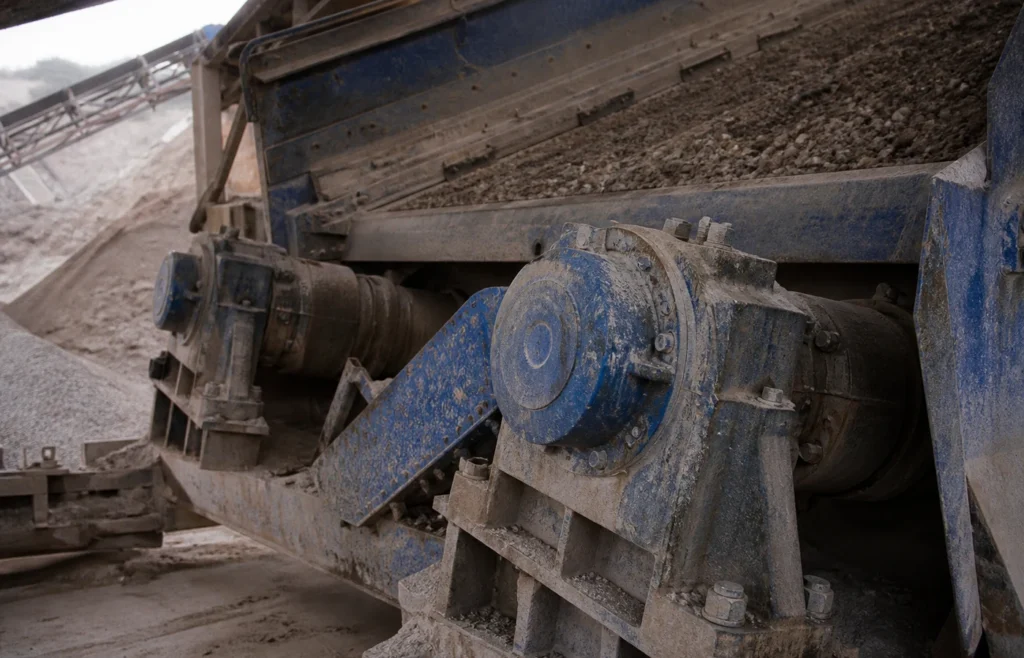
A typical service position for TC Series Double Lip Shaft Seals.
The duty of TC Series Double Lip Shaft Seals is sealing the point where a shaft leaves a housing — keeping the lubricant in and dirt, water and dust out of the bearing behind it. A spring-loaded elastomer lip runs on the shaft surface, and it is the shaft finish and the elastomer compound, not the seal body, that decide how long it lasts. The sections that follow cover the sectors that specify them, how to state the designation, clearance, sealing, cage and fit on an order, how to mount them, and the known limits of the type. Dimensions are to DIN 3760 / ISO 6194-1. This series is catalogued from 22 mm to 125 mm bore; the full table of boundary dimensions is further down the page.
Typical Applications for TC Series Double Lip Shaft Seals
The machine positions and sectors where this type is specified:
Agricultural and mobile equipment: axial V-ring seals flicking mud and water away from the housing entry before it reaches the lip.
Maintenance and repair (MRO): replacing a failed bearing where the original designation, clearance group and sealing have to be matched exactly.
OEM machine building: designed-in shaft support on new equipment, specified from the load, speed and envelope at the design stage.
Bearing housings and gearboxes: sealing the shaft exit so the lubricant stays in the housing and contamination stays out of the bearing.
Bearing housings and pedestals: sealing the shaft exit of a plummer block or a pillow block so the grease stays in and washdown water stays out.
How to Specify TC Series Double Lip Shaft Seals for Your Application
Bore: Start from the bore the shaft or housing gives you — this series is catalogued from 22 mm to 125 mm — then check the outer diameter and width against the space available. The boundary dimensions are fixed by the standard, so they are the same from any manufacturer; the load ratings and limiting speeds are not, and belong to the specific bearing being supplied.
Elastomer and lip: State the shaft diameter, housing bore, width, lip arrangement (single lip, dust lip) and elastomer. The elastomer sets the temperature and chemical limits, and it is the field most often missing from an order.
Dimensions and type: State the shaft diameter, the housing bore and the width, and the seal type — single lip, double lip with a dust lip, or an axial V-ring that runs against a face rather than in a bore.
Elastomer: The elastomer sets the temperature range, the chemical compatibility and the permissible surface speed. It is the field most often left off an order, and the one that most often explains a seal that failed early.
Designation and suffixes: State the complete designation including every suffix. The base number gives the type and the boundary dimensions; the suffixes carry the sealing, the cage, the clearance group, the tolerance class and any special execution — and two bearings whose base numbers match but whose suffixes differ are not interchangeable.
Clearance and tolerance: State the running clearance or fit class the assembly requires, together with the tolerances of the mating parts that produce it. For this type the clearance is created by the parts around the bearing rather than being built into it, which is precisely why it has to be written down.
Seal or shield: State open, shielded (ZZ, 2Z) or sealed (2RS, 2RZ). A shield is non-contacting: it excludes coarse contamination and costs nothing in speed. A contact seal excludes fine dust and water and retains grease, but it rubs — it adds drag, raises the running temperature and lowers the permissible speed. Sealed bearings are also greased for life and cannot be relubricated.
Cage: not applicable: This part has no cage and no rolling elements to separate, so the equivalent decision is the sliding material or liner. That is stated above, and it plays the same role: it is what sets the temperature limit and the lubrication requirement.
Shaft and housing fit: Specify the seat tolerances, not just the bearing. The rule is that the ring which rotates relative to the load direction takes the interference fit: for a rotating inner ring under normal radial load the shaft seat is typically k5 or k6 with the housing bore H7, and where the outer ring rotates the interference moves to the housing (N7 or P7) with a clearance fit (g6) on the shaft. Heavier loads and hollow shafts move the fits tighter. A correctly chosen bearing in the wrong fit fails anyway — too loose and the ring creeps and frets its seat, too tight and the interference consumes the internal clearance and the bearing runs preloaded.
Standard: Boundary dimensions are to DIN 3760 / ISO 6194-1. Quoting the standard on the order guarantees the mounting dimensions are interchangeable between suppliers — it does not standardize load ratings, limiting speeds or internal design, which remain manufacturer-specific.
Mounting & Assembly Practice
Fit with the lip facing the medium being retained — a seal fitted backward leaks from the first hour and looks perfectly installed.
Never pull a lip over an unchamfered shaft end, a keyway or a thread. Use a fitting sleeve; a lip nicked during assembly leaks immediately.
Press on the outer case with a flat tool over its full diameter, square to the bore. A cocked seal distorts the case and the lip runs eccentric.
Inspect the shaft at the seal track. A groove worn by the previous seal is a leak path: repair it with a thin-wall sleeve or move the new seal axially along the shaft.
Common Selection Mistakes with TC Series Double Lip Shaft Seals
Choosing the seal on dimensions alone and leaving the elastomer to the supplier, then finding an NBR lip hardened by an operating temperature that required FKM.
Fitting a new seal onto a shaft with a worn running track, which leaks regardless of the seal.
Running a lip seal dry. The lip is lubricated by a controlled film of the medium it retains; a seal that runs dry burns its contact band within minutes.
Sizing this bearing from the boundary dimensions alone. Load ratings and limiting speeds are manufacturer-specific for this series and are deliberately not published here — take them from the catalog of the bearing actually being supplied and calculate the life against them.
Where TC Series Double Lip Shaft Seals Are Not the Right Choice
Not a substitute for a bearing seal where the bearing itself needs protecting — the shaft seal guards the housing exit.
A shaft seal carries no bearing load and locates nothing. It seals a shaft exit and nothing else.
Not for a rough, soft or damaged shaft surface — the shaft is half of the sealing interface and its finish and hardness are part of the specification.
Not for pressure, unless a pressure-rated design is specified: an ordinary radial lip seal is designed for approximately atmospheric pressure behind it.
Not for surface speeds above the rating of the elastomer, where the frictional heat in the contact band destroys the lip.
From this duty to a part number
This page is about where the bearing goes; the numbers live next door. The TC Series Double Lip Shaft Seals dimension table carries every size in the range, with the drawing and the tolerance notes beside it.
If the shaft diameter is already fixed by the machine, the 50 mm bore, 55 mm bore and 60 mm bore pages narrow the table to that one size.
Another position where TC Series Double Lip Shaft Seals are specified.
Technical Drawing
Customize the parameters below — every spec field is editable, and the drawing redraws to match the values you choose. Changing the designation snaps the other fields to that size's standard values; you can then override any individual value.
Sends the selected values to the quote form below.
Request a Quote
The form below follows the current technical drawing configuration. Change the drawing values above and the request details update automatically.
Our facility
From this page to a production run
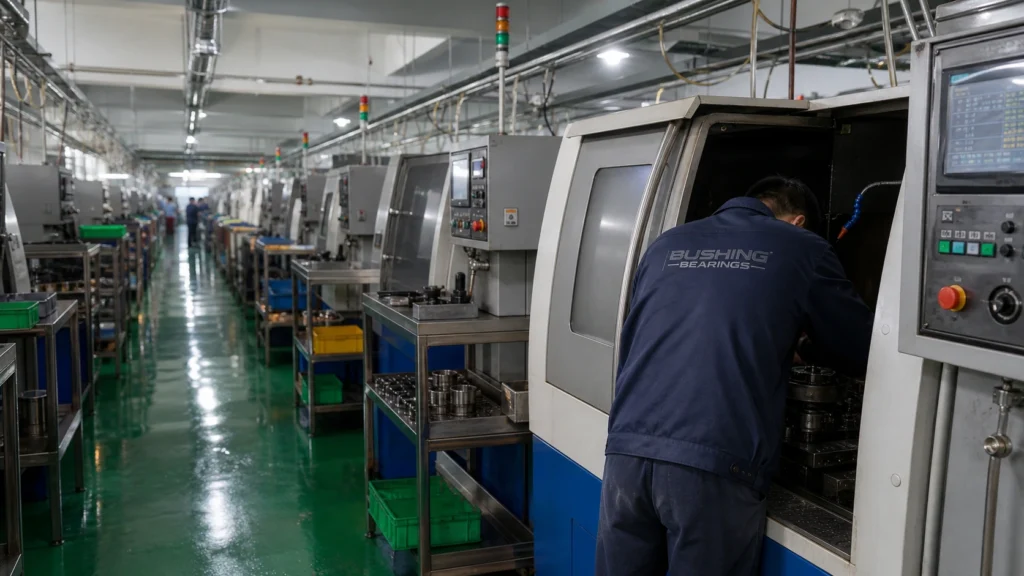
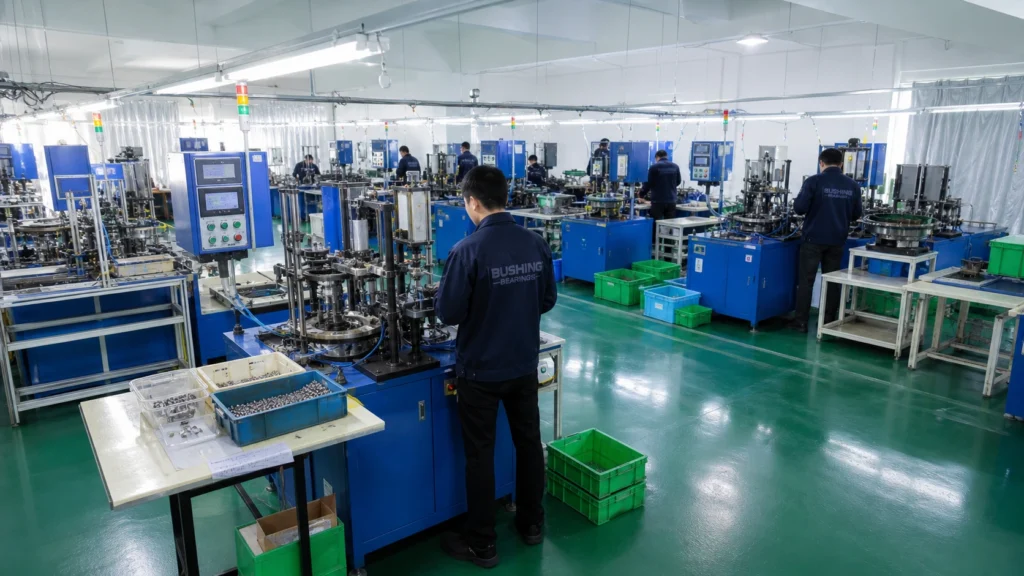
The same plant that makes the sample makes the series: forging, heat treatment, grinding, clearance-set assembly and vibration testing in-house, with the lot number travelling in the carton so a field failure can be traced back to a steel heat.
Dimensions & Specifications (DIN 3760 / ISO 6194-1)
Designation
Shaft diameter d (mm)
Housing bore D (mm)
Width B (mm)
Lip type
Elastomer
Operating temperature range (u00b0C)
TC 10x22x7
10
22
7
Spring loaded main lip plus dust lip
NBR
-30 to +100
TC 12x24x7
12
24
7
Spring loaded main lip plus dust lip
NBR
-30 to +100
TC 15x26x7
15
26
7
Spring loaded main lip plus dust lip
NBR
-30 to +100
TC 15x30x7
15
30
7
Spring loaded main lip plus dust lip
NBR
-30 to +100
TC 17x30x7
17
30
7
Spring loaded main lip plus dust lip
NBR
-30 to +100
TC 17x35x7
17
35
7
Spring loaded main lip plus dust lip
NBR
-30 to +100
TC 20x35x7
20
35
7
Spring loaded main lip plus dust lip
NBR
-30 to +100
TC 20x40x7
20
40
7
Spring loaded main lip plus dust lip
NBR
-30 to +100
TC 25x40x7
25
40
7
Spring loaded main lip plus dust lip
NBR
-30 to +100
TC 25x47x7
25
47
7
Spring loaded main lip plus dust lip
NBR
-30 to +100
TC 28x47x7
28
47
7
Spring loaded main lip plus dust lip
NBR
-30 to +100
TC 30x42x7
30
42
7
Spring loaded main lip plus dust lip
NBR
-30 to +100
TC 30x47x7
30
47
7
Spring loaded main lip plus dust lip
NBR
-30 to +100
TC 30x52x7
30
52
7
Spring loaded main lip plus dust lip
NBR
-30 to +100
TC 32x47x7
32
47
7
Spring loaded main lip plus dust lip
NBR
-30 to +100
TC 32x52x7
32
52
7
Spring loaded main lip plus dust lip
NBR
-30 to +100
TC 35x47x7
35
47
7
Spring loaded main lip plus dust lip
NBR
-30 to +100
TC 35x52x7
35
52
7
Spring loaded main lip plus dust lip
NBR
-30 to +100
TC 35x55x8
35
55
8
Spring loaded main lip plus dust lip
NBR
-30 to +100
TC 40x55x8
40
55
8
Spring loaded main lip plus dust lip
NBR
-30 to +100
TC 40x62x8
40
62
8
Spring loaded main lip plus dust lip
NBR
-30 to +100
TC 45x62x8
45
62
8
Spring loaded main lip plus dust lip
NBR
-30 to +100
TC 45x65x8
45
65
8
Spring loaded main lip plus dust lip
NBR
-30 to +100
TC 50x68x8
50
68
8
Spring loaded main lip plus dust lip
NBR
-30 to +100
TC 50x72x8
50
72
8
Spring loaded main lip plus dust lip
NBR
-30 to +100
TC 55x72x8
55
72
8
Spring loaded main lip plus dust lip
NBR
-30 to +100
TC 55x80x8
55
80
8
Spring loaded main lip plus dust lip
NBR
-30 to +100
TC 60x80x8
60
80
8
Spring loaded main lip plus dust lip
NBR
-30 to +100
TC 60x85x8
60
85
8
Spring loaded main lip plus dust lip
NBR
-30 to +100
TC 65x85x10
65
85
10
Spring loaded main lip plus dust lip
NBR
-30 to +100
TC 70x90x10
70
90
10
Spring loaded main lip plus dust lip
NBR
-30 to +100
TC 75x95x10
75
95
10
Spring loaded main lip plus dust lip
NBR
-30 to +100
TC 80x100x10
80
100
10
Spring loaded main lip plus dust lip
NBR
-30 to +100
TC 85x110x12
85
110
12
Spring loaded main lip plus dust lip
NBR
-30 to +100
TC 90x120x12
90
120
12
Spring loaded main lip plus dust lip
NBR
-30 to +100
TC 100x125x12
100
125
12
Spring loaded main lip plus dust lip
NBR
-30 to +100
Video: What Are TC Series Double Lip Shaft Seals Used For? in use
Third-party video, selected automatically for this topic. It is not produced by Bushing Bearings and is not a specification source — use the tables on this page for dimensional data.
Inside the plant
Manufactured in our own plant
This bearing is forged, hardened, ground, superfinished and clearance-set in-house. The stages below are where its tolerance class, its internal clearance and its noise grade are actually decided.
01
Forging & turning
GCr15 bar and tube is cut, heated and forged into ring blanks, then turned to leave a uniform grinding allowance. Forging rather than machining from solid keeps the grain flow following the raceway, which is the surface that eventually fails.
Blank dimensions and grinding stock checked at set-up and per shift.
02
Heat treatment
Through-hardening brings GCr15 / 100Cr6 to 58–64 HRC; carburizing case-hardens 20CrMnTi where the section is heavy or the load is shock. Rings are then stabilized so they hold size in service rather than growing in the housing.
Core and surface hardness per lot; retained austenite and dimensional stability to the ordered temperature class.
03
Raceway grinding
Faces, bore, outer diameter and raceway are ground in sequence on separate machines. This is where the tolerance class is created: P0, P6, P5 or P4 is a grinding outcome, not a sorting outcome.
Bore and outer diameter deviation, raceway roundness and face runout measured to ISO 492 on every setup.
04
Honing & superfinishing
The ground raceway is honed to remove the grinding lay and bring surface roughness down to a fraction of a micrometre. Raceway finish is what decides whether a lubricant film forms, and therefore what decides bearing life far more than the load rating alone.
Surface roughness Ra and waviness measured per lot.
Frequently Asked Questions
Which industries use TC Series Double Lip Shaft Seals?
They are commonly specified in oem machine building, bearing housings and gearboxes and bearing housings and pedestals, among other sectors.
Which elastomer should a shaft seal be?
NBR for general mineral oil and grease duty within its temperature range; FKM where the temperature is higher or the medium is aggressive; EPDM for water, glycol and brake fluid but never for mineral oil; silicone for a wide temperature range at low speed and pressure. The elastomer, not the lip geometry, is usually what decides whether a seal survives.
Which way round does a shaft seal go?
The lip faces the medium being retained — into the housing, toward the oil or grease. The spring side is the pressure side. A seal fitted the other way round looks correctly installed and leaks from the first hour of running.
Does the shaft surface matter?
It is half the seal. The running track should be hardened, ground to a fine finish and free of a lead pattern from machining, because a helical machining lead pumps the lubricant out along the shaft. A track worn by a previous seal leaks whatever new seal is fitted to it.
Can I get a quote for TC Series Double Lip Shaft Seals in the size and specification I need?
Yes. Use the technical drawing and quote form on this page to set the size and options, then send the exact configuration — designation, clearance, sealing and cage — to our team for pricing and lead time.
Need a bearing quote or a spec sheet?Message our engineers on WhatsApp — send a drawing or DIN number and get pricing back fast.Start WhatsApp Chat →
This website uses only necessary and functional cookies to operate, secure, and improve basic website performance.
We do not use advertising cookies, Google Analytics, or cross-site tracking technologies.