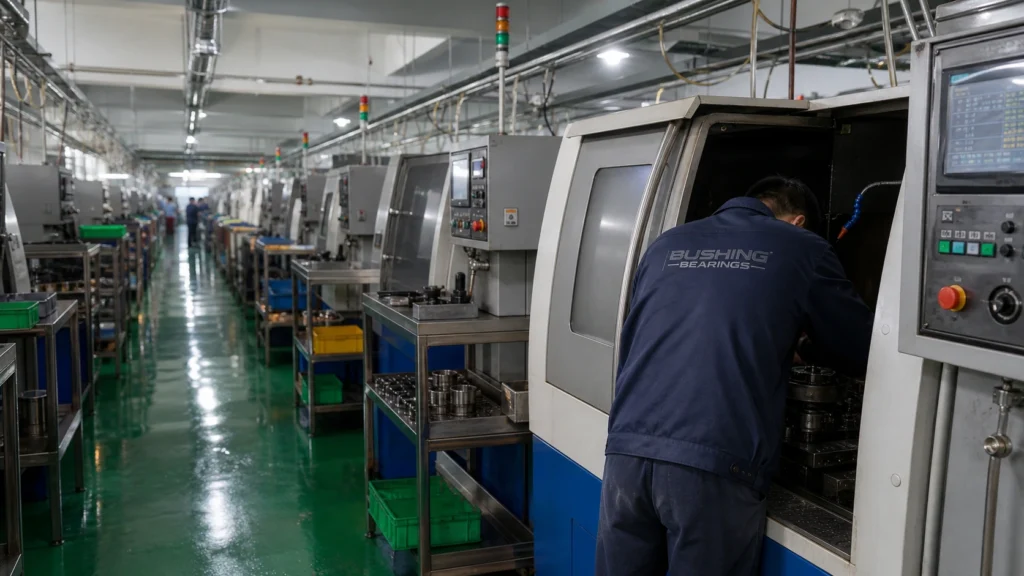
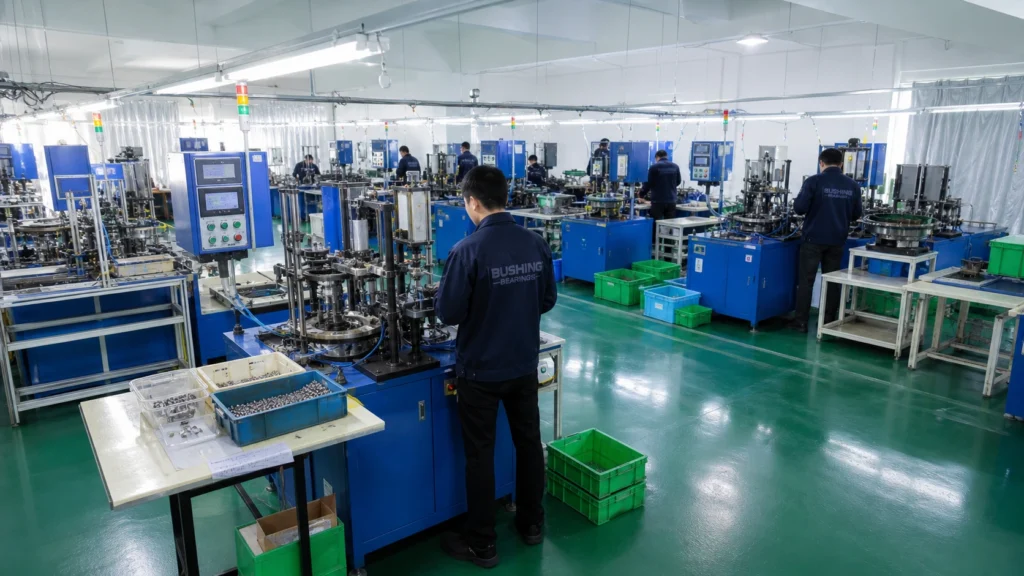
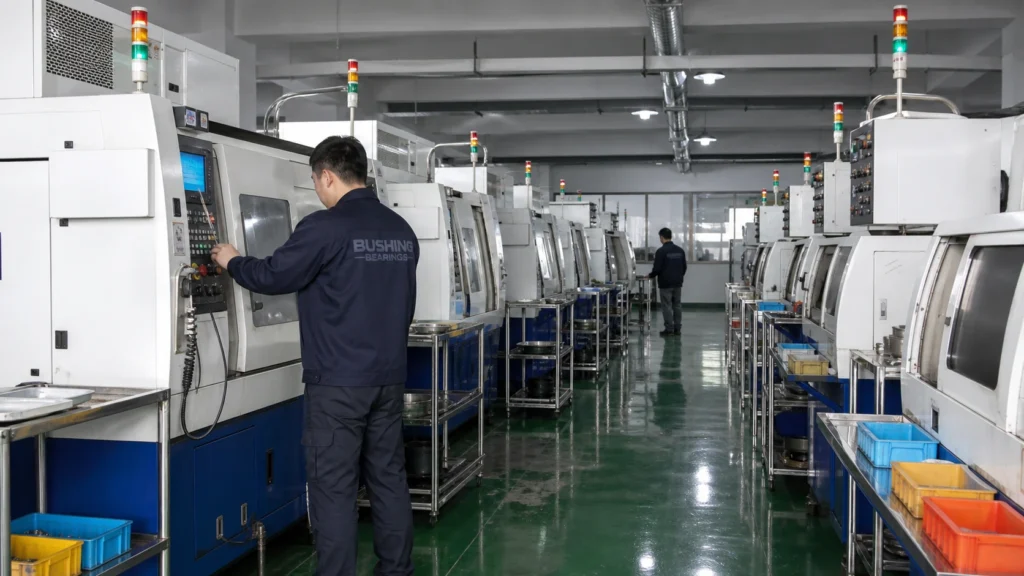
2200K Series Tapered Bore Self-Aligning Ball Bearings are used for carrying radial load on a shaft that is not accurately aligned with its housings, absorbing the misalignment inside the bearing instead of turning it into edge loading. Two rows of balls run in a spherical outer raceway centered on the bearing axis, so the inner ring, balls and cage swivel bodily inside the outer ring: the shaft can sit at an angle to the housing bore and the ball path does not care. This page sets out the industries and machine positions where the type is specified, what has to be stated on the order, mounting practice, and the duties where a different bearing type is the correct answer. Boundary dimensions are to ISO 15 / GB/T 281 / DIN 630. This series is catalogued from 25 mm to 100 mm bore; the full table of boundary dimensions is further down the page.
Typical Applications for 2200K Series Tapered Bore Self-Aligning Ball Bearings
The machine positions and sectors where this type is specified:
- Long line shafts: multi-bearing drive shafts in plant and conveyors, where accumulated tolerance across several pedestals is larger than any rigid bearing will take.
- Fans and blowers: lightly loaded shafts on sheet-metal or bolted-frame supports, where seating accuracy is not economical to hold.
- Conveyors and material handling: idler and drive shafts on welded structures that deflect under load.
- Woodworking and textile machinery: long, slender shafts that deflect measurably between supports.
- Maintenance and repair (MRO): replacing a failed bearing where the original designation, clearance group and sealing have to be matched exactly.
How to Specify 2200K Series Tapered Bore Self-Aligning Ball Bearings for Your Application
- Bore: Start from the bore the shaft or housing gives you — this series is catalogued from 25 mm to 100 mm — then check the outer diameter and width against the space available. The boundary dimensions are fixed by the standard, so they are the same from any manufacturer; the load ratings and limiting speeds are not, and belong to the specific bearing being supplied.
- Adapter sleeve: A tapered bore mounts on an adapter sleeve, so state the sleeve and the lock nut and washer with the bearing. The sleeve clamps onto plain commercial shafting, which is usually why the arrangement was chosen.
- Permissible misalignment: These bearings tolerate roughly 1.5° to 3° of static misalignment depending on series, and the table on this page states the figure for each. Specify from the misalignment you actually have — this capability is the reason to choose the type, and it is also the reason the axial rating is modest.
- Bore form: A cylindrical bore mounts with an interference fit directly on a shaft seat. A tapered (K) bore mounts on an adapter sleeve, so it can be clamped anywhere along a plain drawn shaft with no machined seat at all — which is often why the type was chosen in the first place.
- Designation and suffixes: State the complete designation including every suffix. The base number gives the type and the boundary dimensions; the suffixes carry the sealing, the cage, the clearance group, the tolerance class and any special execution — and two bearings whose base numbers match but whose suffixes differ are not interchangeable.
- Internal clearance group: State the radial internal clearance: C2 (reduced), CN (normal, and unmarked), C3, C4 or C5. Clearance is consumed after the bearing is fitted — by the interference fit on the shaft, and by the inner ring running hotter than the outer — so a bearing with a tight fit or a hot inner ring is ordered C3 and a bearing mounted lightly at even temperature is left CN. This field is left off orders more often than any other, and the bearing then arrives in the normal group by default.
- Seal or shield: State open, shielded (ZZ, 2Z) or sealed (2RS, 2RZ). A shield is non-contacting: it excludes coarse contamination and costs nothing in speed. A contact seal excludes fine dust and water and retains grease, but it rubs — it adds drag, raises the running temperature and lowers the permissible speed. Sealed bearings are also greased for life and cannot be relubricated.
- Cage material: State the cage. Pressed steel is the default and suits most duties; machined brass takes shock, high temperature and poor lubrication better and is used in large and heavily loaded bearings; polyamide is quiet, light and low-friction but has a temperature limit of about 120 °C and is attacked by aged oil. The cage is not a detail — it is the component that most often sets the real temperature limit of the bearing.
- Shaft and housing fit: Specify the seat tolerances, not just the bearing. The rule is that the ring which rotates relative to the load direction takes the interference fit: for a rotating inner ring under normal radial load the shaft seat is typically k5 or k6 with the housing bore H7, and where the outer ring rotates the interference moves to the housing (N7 or P7) with a clearance fit (g6) on the shaft. Heavier loads and hollow shafts move the fits tighter. A correctly chosen bearing in the wrong fit fails anyway — too loose and the ring creeps and frets its seat, too tight and the interference consumes the internal clearance and the bearing runs preloaded.
- Standard: Boundary dimensions are to ISO 15 / GB/T 281 / DIN 630. Quoting the standard on the order guarantees the mounting dimensions are interchangeable between suppliers — it does not standardize load ratings, limiting speeds or internal design, which remain manufacturer-specific.
Mounting & Assembly Practice
- On a tapered bore and adapter sleeve, tightening the locknut drives the inner ring up the taper and expands it, which consumes internal clearance. Measure the residual clearance with a feeler gauge as you tighten, or use the specified drive-up distance — a sleeve tightened "until firm" preloads the bearing.
- The spherical outer raceway means the housing bore does not need to be aligned with the shaft, but it does need to be round and the correct size: the outer ring still takes its fit from the bore.
- Seat both bearings on a shaft before final tightening, then turn the shaft by hand — the outer rings will find their own angle, and any stiffness at that stage is a fit problem, not an alignment one.
Common Selection Mistakes with 2200K Series Tapered Bore Self-Aligning Ball Bearings
- Tightening the sleeve nut by feel. Driving the bearing up the taper expands the inner ring and consumes internal clearance; without measuring the reduction, the bearing is preloaded at the moment of assembly.
- Using the type as a thrust bearing. The shallow spherical outer raceway is not a thrust face, and the axial rating is a small fraction of the radial one.
- Choosing a self-aligning ball bearing for a heavily loaded position that also deflects. Alignment freedom is only half the requirement; a spherical roller bearing gives the same freedom with several times the load rating.
- Assuming the bearing accommodates continuous dynamic misalignment — it accommodates a static angle, and a shaft that whips through an angle every revolution works the ball path and the cage.
- Sizing this bearing from the boundary dimensions alone. Load ratings and limiting speeds are manufacturer-specific for this series and are deliberately not published here — take them from the catalog of the bearing actually being supplied and calculate the life against them.
Where 2200K Series Tapered Bore Self-Aligning Ball Bearings Are Not the Right Choice
- Not for a shaft that already has a machined bearing seat — a cylindrical bore fitted directly is simpler and more concentric.
- Not for axial load of any significance. A duty with meaningful thrust needs the thrust taken by another bearing.
- Not for heavy radial load. Two rows of balls in a spherical raceway make a smaller contact area than a roller of the same envelope; this is the alignment-tolerant type, not the high-capacity one.
- Not a substitute for aligning the machine. It removes the consequence of seat misalignment, not the misalignment itself — shaft deflection large enough to need 3° of freedom is usually a shaft that is too slender.
- The alignment capability is for a static angle between the shaft and the housing seat; it is not a licence to leave a shaft line unaligned, and it does not absorb misalignment that changes every revolution.