
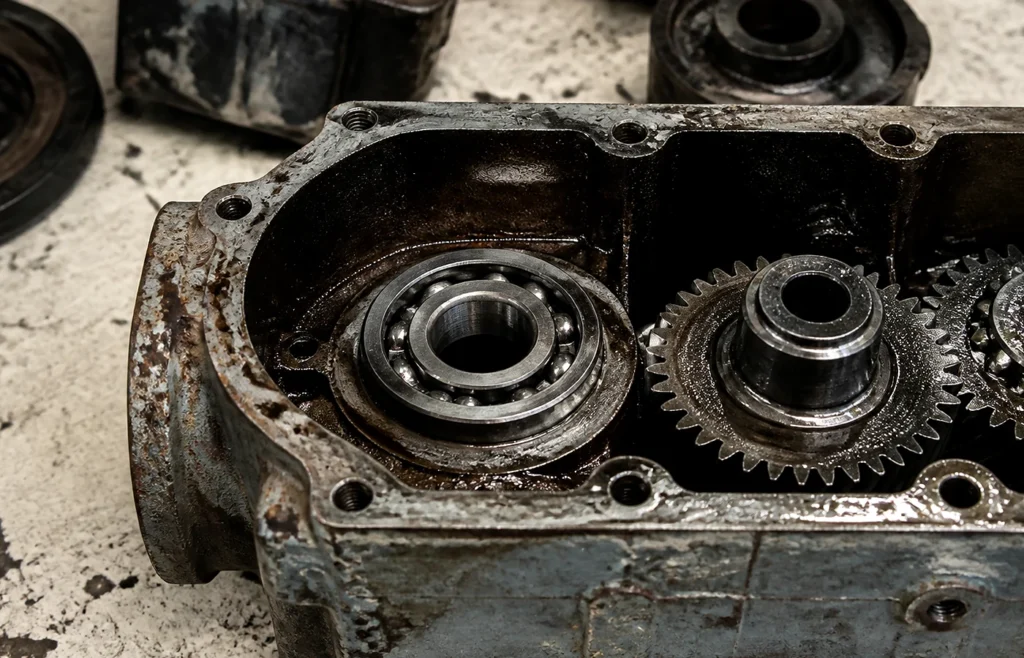
For 51400 series thrust ball bearings, DIN 711 is one of the controlling documents. The sections below describe its scope, the properties it does NOT decide and which standard does decide them, the equivalent designations, and the full size range.
DIN 711 — Scope
DIN 711 is the German standard for single direction thrust ball bearings — the 51100 to 51400 series of shaft washer, housing washer and ball cage — restating the ISO 104 boundary dimensions d, D and assembled height H.
What DIN 711 Does Not Fix
It fixes the envelope only. It does not state the axial load rating (ISO 281 and ISO 76), and it cannot tell you the minimum axial load the bearing needs to keep its balls rolling — a thrust ball bearing run too lightly skids and smears.
This division of labour is the thing to carry away from any bearing standard. A boundary dimension standard makes bearings interchangeable; it does not make them equivalent. Two bearings of the same designation from different makers mount in the same seat and are not required to have the same load rating, the same internal design, the same cage or the same speed limit.
Dimensions Supplied to DIN 711
| Designation | Bore d (mm) | Outer diameter D (mm) | Height H (mm) | Chamfer r min (mm) |
|---|---|---|---|---|
| 51405 | 25 | 60 | 24 | 1 |
| 51406 | 30 | 70 | 28 | 1 |
| 51407 | 35 | 80 | 32 | 1.1 |
| 51408 | 40 | 90 | 36 | 1.1 |
| 51409 | 45 | 100 | 39 | 1.1 |
| 51410 | 50 | 110 | 43 | 1.5 |
| 51411 | 55 | 120 | 48 | 1.5 |
| 51412 | 60 | 130 | 51 | 1.5 |
| 51413 | 65 | 140 | 56 | 2 |
| 51414 | 70 | 150 | 60 | 2 |
| 51415 | 75 | 160 | 65 | 2 |
| 51416 | 80 | 170 | 68 | 2.1 |
| 51417 | 85 | 180 | 72 | 2.1 |
| 51418 | 90 | 190 | 77 | 2.1 |
| 51420 | 100 | 210 | 85 | 3 |
National Equivalents
ISO 104 internationally, GB/T 301 in China; the double direction version is DIN 715.
This product is supplied against ISO 104 / DIN 711 / GB/T 301, which names the documents it is made to.
When to Cite DIN 711
DIN 711 remains in daily use in European mechanical engineering and on legacy drawings, and it is what many German-language datasheets cite. For a new design the ISO document is the better contractual reference, with the DIN number carried alongside it so that the drawing reads the same to everyone.



