
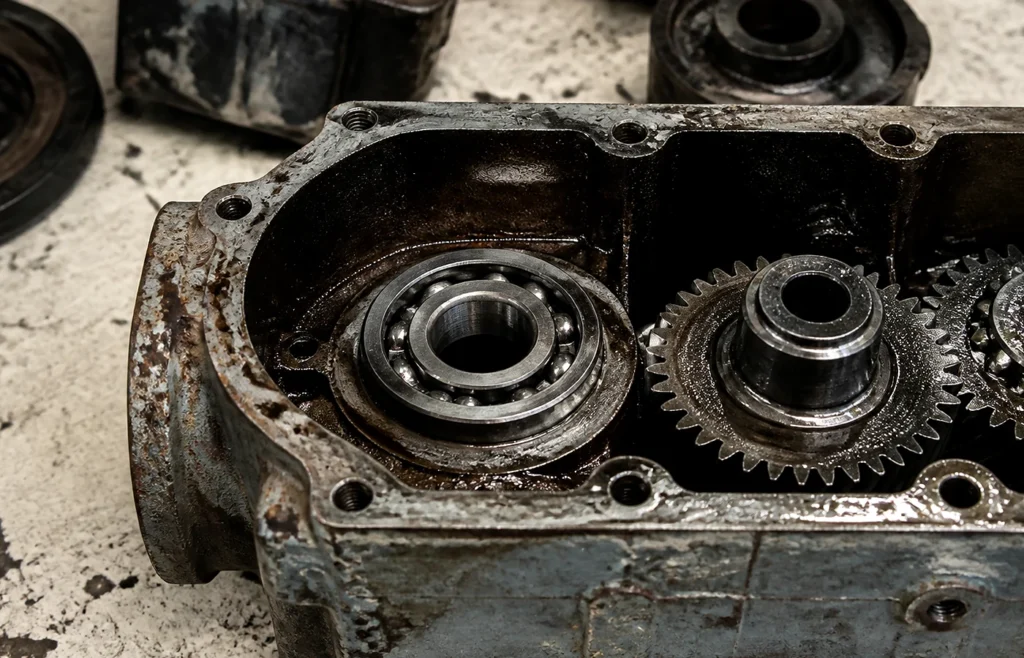
Material specification page for 51300 series thrust ball bearings in Polyamide Cage. Covers the grade designation (glass-fiber reinforced PA66, injection molded as a one-piece snap cage (suffix TVP / TVH depending on the maker)), what the material does inside the bearing, its temperature and environmental limits, the alternatives worth considering, and the sizes available to ISO 104 / DIN 711 / GB/T 301.
Why Polyamide Cage for 51300 Series Thrust Ball Bearings
Light, quiet and low friction, and it survives momentary misalignment and starved starts better than a steel cage; it is also the reason a polyamide-caged bearing cannot be run to the temperature limit of its own rings. In a 51300 series thrust ball bearings it is the cage, which spaces the rolling elements and keeps them from touching each other.
A moulded polyamide cage is light, quiet and forgiving: it runs with less friction than a steel cage, tolerates momentary misalignment and shock, and survives a starved start that would let a steel cage wear. Its price is a temperature ceiling well below the rings'.
Material Properties
| Grade designation | glass-fiber reinforced PA66, injection molded as a one-piece snap cage (suffix TVP / TVH depending on the maker) |
|---|---|
| Magnetic response | Non-magnetic |
| Service temperature | Continuous service to about +120 °C — above that the polyamide ages rapidly, and it is the cage rather than the steel that ends the bearing |
| Corrosion characteristic | Unaffected by ordinary mineral greases and oils; aged prematurely by some synthetic oils and by aggressive EP additives at temperature |
Service Limits
Temperature is the limit, and it is a limit on the BEARING, not just on the cage: about +120 °C continuous, with the polyamide aging rapidly above that, especially in the presence of an oil with aggressive EP additives. A bearing that runs at 130 °C should not be ordered with a polyamide cage even though its rings would be perfectly content there.
What the Material Changes About the Bearing
The cage carries no load, so it changes no rating. What it changes is the operating envelope: the maximum temperature, the maximum speed, the tolerance of shock and vibration, the noise, and the compatibility with the lubricant. A bearing is very often limited by its cage long before its rings are in any danger, which is why the cage suffix in a designation is not a detail.
Sizes of 51300 Series Thrust Ball Bearings Available in Polyamide Cage
| Designation | Bore d (mm) | Outer diameter D (mm) | Height H (mm) | Chamfer r min (mm) |
|---|---|---|---|---|
| 51305 | 25 | 52 | 18 | 1 |
| 51306 | 30 | 60 | 21 | 1 |
| 51307 | 35 | 68 | 24 | 1 |
| 51308 | 40 | 78 | 26 | 1 |
| 51309 | 45 | 85 | 28 | 1 |
| 51310 | 50 | 95 | 31 | 1.1 |
| 51311 | 55 | 105 | 35 | 1.1 |
| 51312 | 60 | 110 | 35 | 1.1 |
| 51313 | 65 | 115 | 36 | 1.1 |
| 51314 | 70 | 125 | 40 | 1.1 |
| 51315 | 75 | 135 | 44 | 1.5 |
| 51316 | 80 | 140 | 44 | 1.5 |
| 51317 | 85 | 150 | 49 | 1.5 |
| 51318 | 90 | 155 | 50 | 1.5 |
| 51320 | 100 | 170 | 55 | 1.5 |



