Skip to content
info@bushingbearings.com +86 15999653684

Angular Contact Ball Bearings · ISO 15 / DIN 628-1 / GB/T 292

Zirconia ZrO2 7300B Series Angular Contact Ball Bearings

Density, insulation and speed capability, corrosion behavior, and where a hybrid beats a full ceramic bearing.

Zirconia ZrO2 7300B Series Angular Contact Ball Bearings are made from yttria-stabilized zirconia to ASTM F2393, density about 6.0 g/cm³. Corrosion behavior: inert, including in seawater, brine and many acids. The material is non-magnetic, and an electrical insulator, and the usable service range is stable well beyond the rest of the bearing; its thermal expansion is closer to steel than silicon nitride, which makes a mixed steel/zirconia assembly less sensitive to temperature change. In practice this material is tougher but softer and less stiff than silicon nitride — it is the full-ceramic choice for wet and chemically aggressive service rather than the high-speed one.

Material
yttria-stabilized zirconia to ASTM F2393, density about 6.0 g/cm³
Corrosion resistance
Inert, including in seawater, brine and many acids
Magnetic response
Non-magnetic, and an electrical insulator
Service temperature
stable well beyond the rest of the bearing; its thermal expansion is closer to steel than silicon nitride, which makes a mixed steel/zirconia assembly less sensitive to temperature change

Property figures are typical for the material. In an assembled bearing the lubricant, the seals and the cage frequently reach their limits before the material does, so check all four against the duty. Material certification is available on request for production orders.

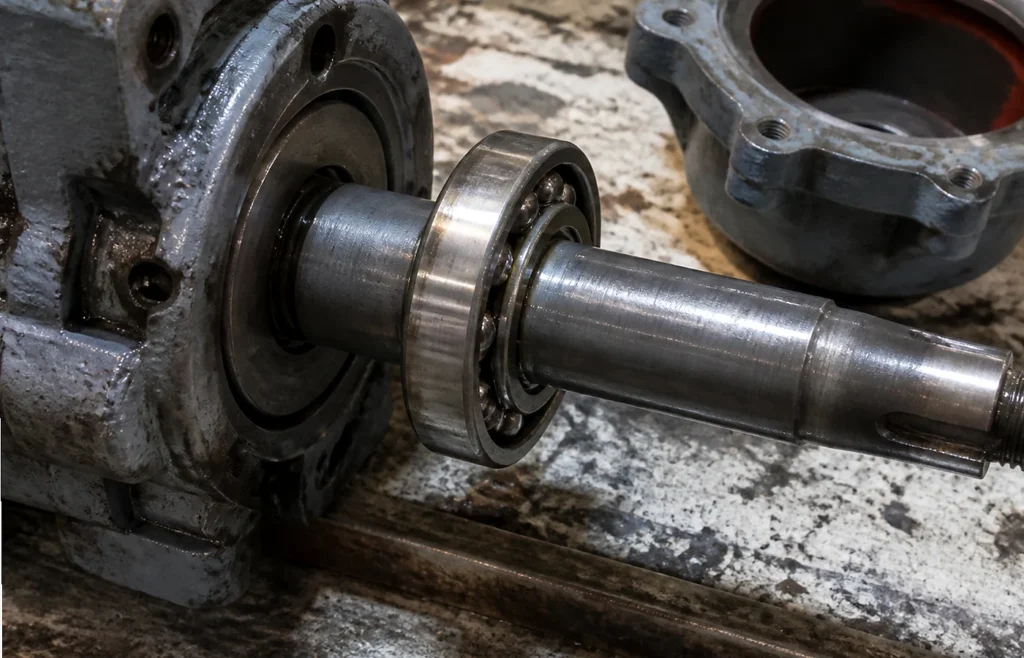
Pump shaft bearing — 7300B Series Angular Contact Ball Bearings in service

Zirconia ZrO2 7300B Series Angular Contact Ball Bearings are dimensioned to ISO 15 / DIN 628-1 / GB/T 292 exactly as the standard version is: the material changes the properties, never the envelope. What it does change — inert, including in seawater, brine and many acids, non-magnetic, and an electrical insulator and the service range stable well beyond the rest of the bearing; its thermal expansion is closer to steel than silicon nitride, which makes a mixed steel/zirconia assembly less sensitive to temperature change — is set out below with the full size chart.

Why Zirconia ZrO2 for 7300B Series Angular Contact Ball Bearings

Tougher but softer and less stiff than silicon nitride — it is the full-ceramic choice for wet and chemically aggressive service rather than the high-speed one. In a 7300b series angular contact ball bearings it is the rolling element material — the balls, with the rings left in steel in a hybrid bearing.

Zirconia is chosen where the environment attacks steel — seawater, brine, chemicals, or a process that must not be contaminated by iron — and where a full-ceramic bearing running unlubricated or with the process fluid is the only workable arrangement.

Material Properties

Grade designationyttria-stabilized zirconia to ASTM F2393, density about 6.0 g/cm³
Magnetic responseNon-magnetic, and an electrical insulator
Service temperatureStable well beyond the rest of the bearing; its thermal expansion is closer to steel than silicon nitride, which makes a mixed steel/zirconia assembly less sensitive to temperature change
Corrosion characteristicInert, including in seawater, brine and many acids

Service Limits

Zirconia is less hard and less stiff than silicon nitride, and its load capacity in a full-ceramic bearing is well below a steel bearing of the same size. Full ceramic bearings also run with much lower speed limits than their steel equivalents. Specify one when the chemistry demands it, not when the load or the speed does.

What the Material Changes About the Bearing

In a hybrid bearing the rings stay steel and the balls become ceramic, so the boundary dimensions and the mounting are unchanged. The differences are all dynamic: lower ball mass and therefore lower centrifugal load at speed, a higher permissible speed, less heat generated, electrical insulation through the ball contact, and a bearing that tolerates marginal lubrication better than an all-steel one.

Fitting a Steel Bearing in an Aluminum Housing

Aluminum has roughly twice the coefficient of thermal expansion of bearing steel, so a housing bore machined to a normal H7 fit at room temperature grows away from the outer ring as the machine reaches operating temperature. The outer ring then turns in its seat and wears the bore. Where the housing is aluminum and the temperature rise is more than about 30 degrees C, tighten the housing fit by one grade — J7 or K7 in place of H7 — or fit a steel sleeve into the aluminum. Check the resulting internal clearance: a tighter housing fit takes clearance out of the bearing, which is often why C3 is specified alongside it.

Sizes of 7300B Series Angular Contact Ball Bearings Available in Zirconia ZrO2

DesignationBore d (mm)Outer diameter D (mm)Width B (mm)Chamfer r min (mm)Contact angle a (deg)
7300B1035110.640
7301B123712140
7302B154213140
7303B174714140
7304B2052151.140
7305B2562171.140
7306B3072191.140
7307B3580211.540
7308B4090231.540
7309B45100251.540
7310B5011027240
7311B5512029240
7312B60130312.140
7313B65140332.140
7314B70150352.140
7315B75160372.140
7316B80170392.140
7317B8518041340
7318B9019043340
7319B9520045340
7320B10021547340

Technical Drawing

Customize the parameters below — every spec field is editable, and the drawing redraws to match the values you choose. Changing the designation snaps the other fields to that size's standard values; you can then override any individual value.

Sends the selected values to the quote form below.
Our facility

Where these dimensions are actually made

Ring forging, heat treatment, raceway grinding and superfinishing all happen under one roof, so a bore tolerance and a clearance group are set by processes we control and can evidence, not by whichever supplier had stock.

Bearing production line, wide view
Ring inspection station
Bearing assembly and clearance setting
Finished bearings staged for packing

Request a Quote

The form below follows the current technical drawing configuration. Change the drawing values above and the request details update automatically.

Request a Quotation

Specification
Business Information

Dimensions & Specifications (ISO 15 / DIN 628-1 / GB/T 292)

DesignationBore d (mm)Outer diameter D (mm)Width B (mm)Chamfer r min (mm)Contact angle a (deg)
7300B1035110.640
7301B123712140
7302B154213140
7303B174714140
7304B2052151.140
7305B2562171.140
7306B3072191.140
7307B3580211.540
7308B4090231.540
7309B45100251.540
7310B5011027240
7311B5512029240
7312B60130312.140
7313B65140332.140
7314B70150352.140
7315B75160372.140
7316B80170392.140
7317B8518041340
7318B9019043340
7319B9520045340
7320B10021547340

Video: Zirconia ZrO2 7300B Series Angular Contact Ball Bearings

Third-party video, selected automatically for this topic. It is not produced by Bushing Bearings and is not a specification source — use the tables on this page for dimensional data.

Frequently Asked Questions

What are the limits of Zirconia ZrO2?

Zirconia is less hard and less stiff than silicon nitride, and its load capacity in a full-ceramic bearing is well below a steel bearing of the same size. Full ceramic bearings also run with much lower speed limits than their steel equivalents. Specify one when the chemistry demands it, not when the load or the speed does.

What should I use instead of Zirconia ZrO2?

Silicon nitride is the alternative wherever speed and stiffness matter more than toughness; 440C stainless is the alternative wherever the chemistry is mild enough for a hardened stainless to survive, since it carries far more load.

Does Zirconia ZrO2 change the dimensions or the rating?

In a hybrid bearing the rings stay steel and the balls become ceramic, so the boundary dimensions and the mounting are unchanged. The differences are all dynamic: lower ball mass and therefore lower centrifugal load at speed, a higher permissible speed, less heat generated, electrical insulation through the ball contact, and a bearing that tolerates marginal lubrication better than an all-steel one.

What is the difference between a hybrid and a full ceramic bearing?

A hybrid bearing keeps steel rings and replaces only the rolling elements with ceramic — it carries nearly the load of a steel bearing while gaining speed capability and electrical insulation. A full ceramic bearing has ceramic rings as well: it is immune to corrosion and can run without a conventional lubricant, but its load rating and speed limit are far below the steel equivalent.

How do I request a quotation?

Use the technical drawing on this page to pick the exact configuration, then submit it with the quote form. We respond within one business day.


