
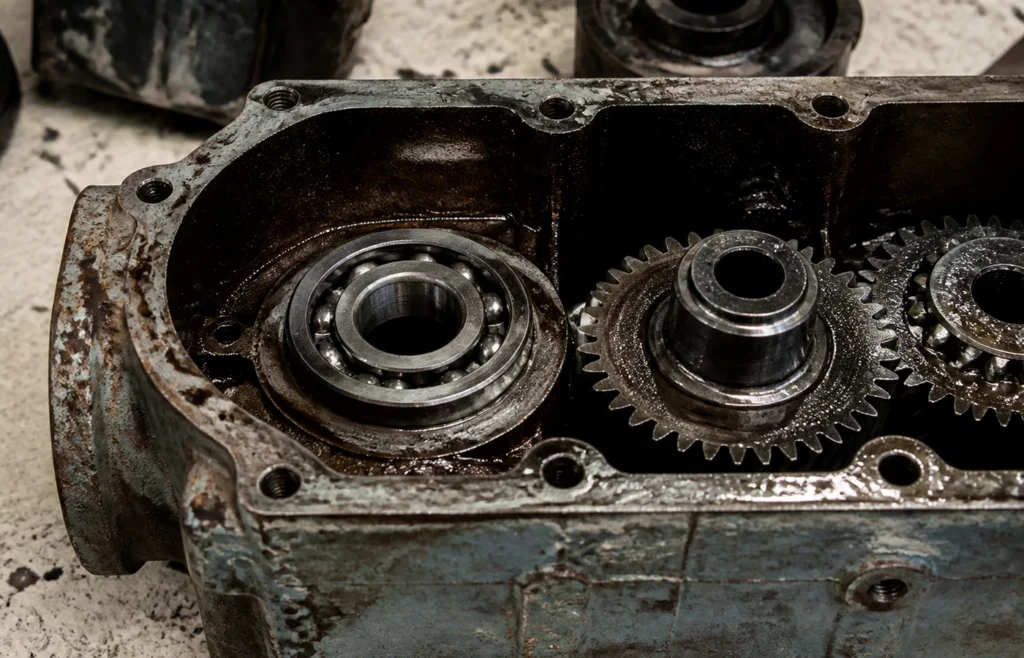
Machined Brass Cage 22300 Series Spherical Roller Bearings are dimensioned to ISO 15 / GB/T 288 / DIN 635-2 exactly as the standard version is: the material changes the properties, never the envelope. What it does change — good in most industrial environments; brass is attacked by ammonia, so it is not used in ammonia refrigeration plant, non-magnetic and the service range the cage itself is good well past the temperature at which the lubricant and the ring stabilization give out — is set out below with the full size chart.
Why Machined Brass Cage for 22300 Series Spherical Roller Bearings
Specified for large bearings, high speed, heavy shock and vibration, and wherever temperature or lubricant rules out polyamide. In a 22300 series spherical roller bearings it is the cage, which spaces the rolling elements and keeps them from touching each other.
A machined brass cage is strong, stable at temperature, and unaffected by the oils and additives that age a polymer cage. It is what large bearings, high-speed bearings and heavily shocked bearings are supplied with.
Material Properties
| Grade designation | machined cast or wrought brass, rolling-element or ring guided (suffix M, MA, MB or MP by maker) |
|---|---|
| Magnetic response | Non-magnetic |
| Service temperature | The cage itself is good well past the temperature at which the lubricant and the ring stabilization give out |
| Corrosion characteristic | Good in most industrial environments; brass is attacked by ammonia, so it is not used in ammonia refrigeration plant |
Service Limits
Brass is attacked by ammonia, so a brass-caged bearing has no place in an ammonia refrigeration plant. The machined cage also weighs more than a pressed or moulded one, which matters for acceleration and for the cage forces at very high speed.
Alternatives and When to Switch
Polyamide is lighter, quieter and cheaper for ordinary speeds and temperatures; pressed steel is the volume standard. Brass earns its cost where the cage forces or the temperature are genuinely beyond both.
Fitting a Steel Bearing in an Aluminum Housing
Aluminum has roughly twice the coefficient of thermal expansion of bearing steel, so a housing bore machined to a normal H7 fit at room temperature grows away from the outer ring as the machine reaches operating temperature. The outer ring then turns in its seat and wears the bore. Where the housing is aluminum and the temperature rise is more than about 30 degrees C, tighten the housing fit by one grade — J7 or K7 in place of H7 — or fit a steel sleeve into the aluminum. Check the resulting internal clearance: a tighter housing fit takes clearance out of the bearing, which is often why C3 is specified alongside it.
Sizes of 22300 Series Spherical Roller Bearings Available in Machined Brass Cage
| Designation | Bore d (mm) | Outer diameter D (mm) | Width B (mm) | Chamfer r min (mm) | Permissible misalignment (deg) |
|---|---|---|---|---|---|
| 22305 | 25 | 62 | 24 | 1.1 | 1.5 |
| 22306 | 30 | 72 | 27 | 1.1 | 1.5 |
| 22307 | 35 | 80 | 31 | 1.5 | 1.5 |
| 22308 | 40 | 90 | 33 | 1.5 | 1.5 |
| 22309 | 45 | 100 | 36 | 1.5 | 1.5 |
| 22310 | 50 | 110 | 40 | 2 | 1.5 |
| 22311 | 55 | 120 | 43 | 2 | 1.5 |
| 22312 | 60 | 130 | 46 | 2.1 | 1.5 |
| 22313 | 65 | 140 | 48 | 2.1 | 1.5 |
| 22314 | 70 | 150 | 51 | 2.1 | 1.5 |
| 22315 | 75 | 160 | 55 | 2.1 | 1.5 |
| 22316 | 80 | 170 | 58 | 2.1 | 1.5 |
| 22317 | 85 | 180 | 60 | 3 | 1.5 |
| 22318 | 90 | 190 | 64 | 3 | 1.5 |
| 22319 | 95 | 200 | 67 | 3 | 1.5 |
| 22320 | 100 | 215 | 73 | 3 | 1.5 |
| 22322 | 110 | 240 | 80 | 3 | 1.5 |



