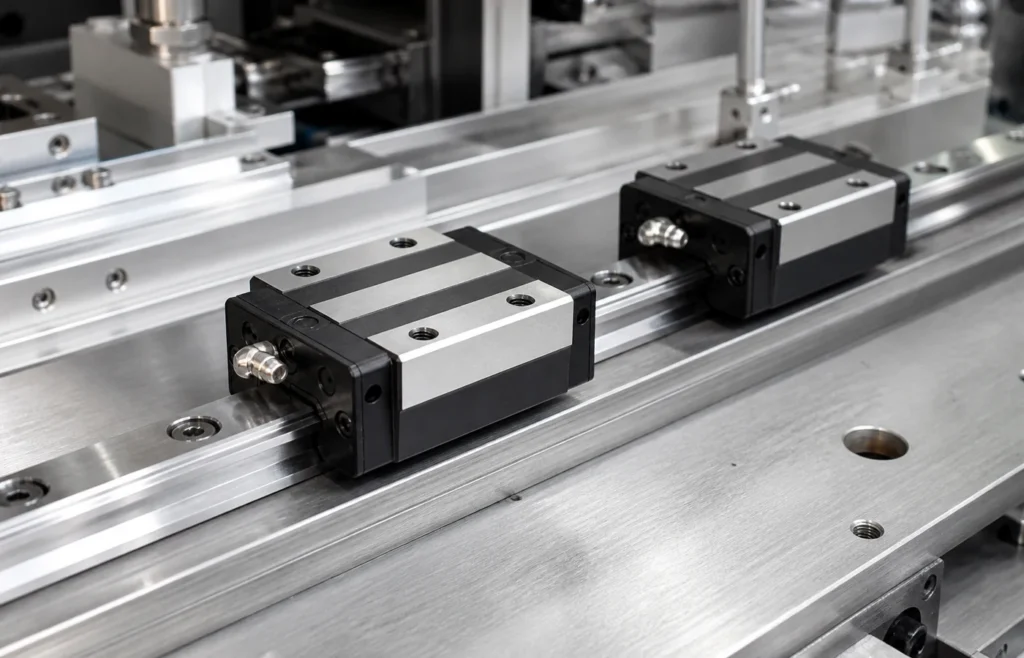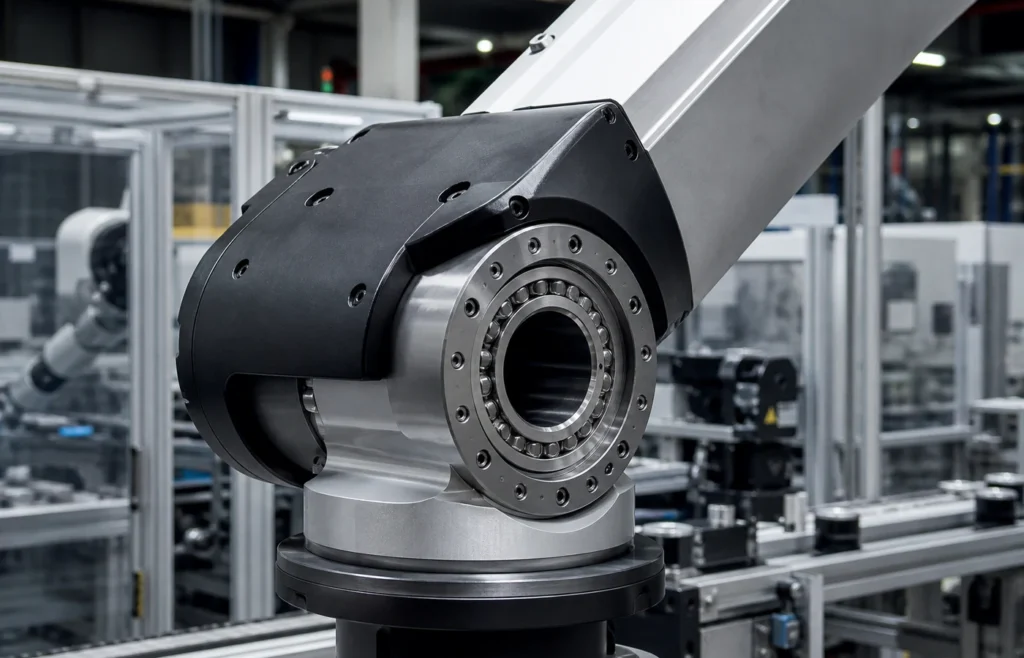
SK Series Shaft Support Blocks are used for guiding motion along a shaft rather than around it — the balls recirculate through the bushing, so the stroke is limited only by the length of the shaft. Each ball track is a closed loop: balls carry load along the straight section, turn out at the end of the stroke and return through the bushing body, so a short bushing supports an unlimited travel. This page sets out the industries and machine positions where the type is specified, what has to be stated on the order, mounting practice, and the duties where a different bearing type is the correct answer. Boundary dimensions are to Manufacturer series (no ISO equivalent). This series is catalogued from 8 mm to 30 mm shaft diameter; the full table of boundary dimensions is further down the page.
Typical Applications for SK Series Shaft Support Blocks
The machine positions and sectors where this type is specified:
- 3D printers and desktop machines: X and Y carriages on ground shafting, where cost and quiet running matter more than load.
- CNC and gantry axes: supported-rail axes on long spans, with open bushings running on shafts that are continuously supported.
- Automation slides and pick-and-place: short, fast strokes where a recirculating bushing is lighter and cheaper than a profile rail.
- Medical and laboratory equipment: smooth, low-noise linear motion on small-diameter shafting.
- Measuring and inspection machines: low-friction guided motion for probes and carriages.
How to Specify SK Series Shaft Support Blocks for Your Application
- Shaft diameter: Start from the shaft diameter the shaft or housing gives you — this series is catalogued from 8 mm to 30 mm — then check the outer diameter and width against the space available. The boundary dimensions are fixed by the standard, so they are the same from any manufacturer; the load ratings and limiting speeds are not, and belong to the specific bearing being supplied.
- Shaft and support together: A supported shaft is a system: specify the hardened ground shaft, the support rail or blocks, and the open bushings that straddle them as one arrangement.
- Bushing form: Closed bushings suit end-supported shafts. Open bushings have a longitudinal slot so they can straddle a continuously supported rail, which is what makes a long span possible — but the slot is a gap in the ball tracks, so the load must not point into it. Pre-assembled units (SC, SCS) put the bushing in a housing block ready to bolt down.
- Shaft specification: The shaft is the raceway. Specify induction-hardened shafting at 58–62 HRC with sufficient case depth, ground and polished to h6 or g6, with a stated straightness. A soft or unhardened shaft is brinelled by the balls within a short time.
- Arrangement: Use two bushings per axis, spaced apart, so the carriage can resist the tilting moment its own load applies. A single bushing under an overhung load jams rather than slides — the ratio of overhang to bearing spacing decides whether the axis works.
- Designation and suffixes: State the complete designation including every suffix. The base number gives the type and the boundary dimensions; the suffixes carry the sealing, the cage, the clearance group, the tolerance class and any special execution — and two bearings whose base numbers match but whose suffixes differ are not interchangeable.
- Clearance and tolerance: State the running clearance or fit class the assembly requires, together with the tolerances of the mating parts that produce it. For this type the clearance is created by the parts around the bearing rather than being built into it, which is precisely why it has to be written down.
- Sealing arrangement: This type is supplied open, so the sealing belongs to the housing around it. Specify the shaft seal, flinger or labyrinth that will keep the lubricant in and contamination out — with an open bearing, the sealing arrangement, not the bearing, decides how long it survives its environment.
- Cage material: State the cage. Pressed steel is the default and suits most duties; machined brass takes shock, high temperature and poor lubrication better and is used in large and heavily loaded bearings; polyamide is quiet, light and low-friction but has a temperature limit of about 120 °C and is attacked by aged oil. The cage is not a detail — it is the component that most often sets the real temperature limit of the bearing.
- Shaft and housing fit: Specify the seat tolerances, not just the bearing. The rule is that the ring which rotates relative to the load direction takes the interference fit: for a rotating inner ring under normal radial load the shaft seat is typically k5 or k6 with the housing bore H7, and where the outer ring rotates the interference moves to the housing (N7 or P7) with a clearance fit (g6) on the shaft. Heavier loads and hollow shafts move the fits tighter. A correctly chosen bearing in the wrong fit fails anyway — too loose and the ring creeps and frets its seat, too tight and the interference consumes the internal clearance and the bearing runs preloaded.
- Standard: Boundary dimensions are to Manufacturer series (no ISO equivalent). Quoting the standard on the order guarantees the mounting dimensions are interchangeable between suppliers — it does not standardize load ratings, limiting speeds or internal design, which remain manufacturer-specific.
Mounting & Assembly Practice
- Press on the outer body of the bushing with a sleeve, never on the ball retainer or the end seals — the retainer is a plastic or thin steel cage and pressing on it releases the balls.
- Align the two shafts of an axis parallel to each other and in the same plane before locking the supports down. Recirculating bushings have almost no misalignment tolerance, and a converging pair binds at one end of the stroke.
- Support long shafts at intervals: an end-supported shaft deflects under its own carriage load, and the deflection shows up as varying friction along the stroke.
- Fit wipers or bellows in any environment producing chips or dust. Recirculating balls carry contamination into the return track and jam.
Common Selection Mistakes with SK Series Shaft Support Blocks
- Using an open bushing with the load pointing into the open slot, where there are no ball tracks to carry it.
- Running on drawn or chrome-plated tube that has not been through-hardened, then finding indentations along the loaded section of the stroke.
- Over-constraining the axis: four bushings on two shafts that are not accurately parallel fight each other for the whole stroke.
Where SK Series Shaft Support Blocks Are Not the Right Choice
- A shaft support carries no bearing load itself and does not replace the bushing; it exists to stop the shaft deflecting.
- Not for rotation. A recirculating linear bushing guides motion along the shaft; it is not a journal bearing and turning the shaft inside it destroys the ball tracks.
- No misalignment tolerance — shafts that are not parallel or not coplanar cause binding and brinelling, not just extra friction.
- Not for heavy moment loads. Where the carriage overhangs, a profile rail guide carries the moment; a round-shaft bushing largely does not.
- Not for contaminated environments without wipers, and not for axial load along the shaft, which the bushing does not carry at all.
- This type will not tolerate misalignment. The rolling or sliding contact is a line, so a fraction of a degree of tilt moves the whole load onto the end of the contact and the stress concentration there is what fails the bearing.