Application guide for 81100 Series Thrust Cylindrical Roller Bearings to ISO 104 / DIN 722 / GB/T 4663. The core duty of the type is carrying pure axial load on a shaft, with no radial capacity of any kind. The raceways are washers rather than rings: a shaft washer, a housing washer and a rolling element set between them, so load passes straight along the shaft axis and nothing in the bearing resists a sideways force. The typical industries, the specification checklist, mounting practice and the exclusion cases are set out below. This series is catalogued from 10 mm to 100 mm bore; the full table of boundary dimensions is further down the page.
Typical Applications for 81100 Series Thrust Cylindrical Roller Bearings
The machine positions and sectors where this type is specified:
- OEM machine building: designed-in shaft support on new equipment, specified from the load, speed and envelope at the design stage.
- Vertical shafts: carrying the weight of the rotating assembly itself, with a radial bearing handling the side load separately.
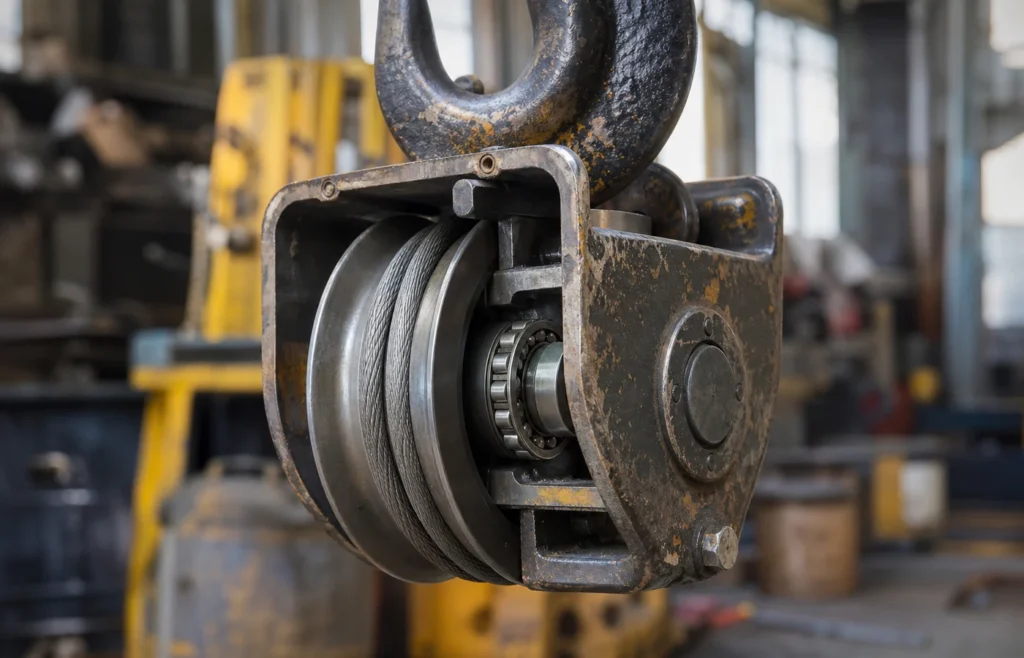
- Crane hooks and swivels: heavy axial load at very low speed, where the load is the whole duty and the rotation is incidental.
- Turntables and rotary tables: index tables and slewing arrangements taking the platform weight and the workpiece.
- Machine tool feed screws: taking the axial reaction of a lead screw or ball screw with the screw located against the bearing.
How to Specify 81100 Series Thrust Cylindrical Roller Bearings for Your Application
- Bore: Start from the bore the shaft or housing gives you — this series is catalogued from 10 mm to 100 mm — then check the outer diameter and width against the space available. The boundary dimensions are fixed by the standard, so they are the same from any manufacturer; the load ratings and limiting speeds are not, and belong to the specific bearing being supplied.
- Flat, square seats: A thrust cylindrical roller bearing has very high axial capacity and almost no tolerance for anything else: both seating faces must be flat and square to the axis, and the type is specified where axial stiffness matters at low speed.
- Direction: Single-direction bearings (51100, 51200 series) take load one way only. Double-direction bearings (52200 series and equivalents) have a center washer and two ball sets, and take load both ways — required whenever the axial load reverses or the shaft must be located.
- Washer bores and height: The shaft washer and housing washer have different bores in most series, and the assembled height H is the dimension the design has to allow for. Do not size the housing on the ring width of a radial bearing table.
- Minimum load and speed: A thrust ball bearing needs a minimum axial load, roughly proportional to the square of the speed, to keep the balls from skidding under centrifugal force. That relationship, not the load rating, is what usually limits the speed of the type.
- Seating: Where the housing face cannot be held square to the shaft, specify a sphered housing washer with a seating ring; a flat washer on an out-of-square face loads one segment of the ball path.
- Designation and suffixes: State the complete designation including every suffix. The base number gives the type and the boundary dimensions; the suffixes carry the sealing, the cage, the clearance group, the tolerance class and any special execution — and two bearings whose base numbers match but whose suffixes differ are not interchangeable.
- Clearance and tolerance: State the running clearance or fit class the assembly requires, together with the tolerances of the mating parts that produce it. For this type the clearance is created by the parts around the bearing rather than being built into it, which is precisely why it has to be written down.
- Sealing arrangement: This type is supplied open, so the sealing belongs to the housing around it. Specify the shaft seal, flinger or labyrinth that will keep the lubricant in and contamination out — with an open bearing, the sealing arrangement, not the bearing, decides how long it survives its environment.
- Cage material: State the cage. Pressed steel is the default and suits most duties; machined brass takes shock, high temperature and poor lubrication better and is used in large and heavily loaded bearings; polyamide is quiet, light and low-friction but has a temperature limit of about 120 °C and is attacked by aged oil. The cage is not a detail — it is the component that most often sets the real temperature limit of the bearing.
- Shaft and housing fit: Specify the seat tolerances, not just the bearing. The rule is that the ring which rotates relative to the load direction takes the interference fit: for a rotating inner ring under normal radial load the shaft seat is typically k5 or k6 with the housing bore H7, and where the outer ring rotates the interference moves to the housing (N7 or P7) with a clearance fit (g6) on the shaft. Heavier loads and hollow shafts move the fits tighter. A correctly chosen bearing in the wrong fit fails anyway — too loose and the ring creeps and frets its seat, too tight and the interference consumes the internal clearance and the bearing runs preloaded.
- Standard: Boundary dimensions are to ISO 104 / DIN 722 / GB/T 4663. Quoting the standard on the order guarantees the mounting dimensions are interchangeable between suppliers — it does not standardize load ratings, limiting speeds or internal design, which remain manufacturer-specific.
Mounting & Assembly Practice
- Fit the shaft washer to the shaft and the housing washer to the housing, and check them against the table before assembly — the two bores differ, and they are easy to swap.
- Both seating faces must be square to the shaft axis. An out-of-square face concentrates the whole load on a fraction of the balls, and this is the most common cause of early thrust bearing failure.
- Keep a minimum axial load on the bearing at all times, including at start-up and during no-load running: springs are commonly used to maintain it.
- Support the housing washer over its full face. A washer bridging a recess deflects and the ball path follows the deflection.
Common Selection Mistakes with 81100 Series Thrust Cylindrical Roller Bearings
- Expecting a thrust bearing to support the shaft radially, and providing no radial bearing at all. It has zero radial capacity — the washers simply slide.
- Running a thrust ball bearing at a speed the load cannot support, so the balls skid, smear the raceway and fail with no fatigue damage at all.
- Using a single-direction bearing where the load reverses momentarily on deceleration; the ball set unloads completely and the assembly rattles.
- Sizing this bearing from the boundary dimensions alone. Load ratings and limiting speeds are manufacturer-specific for this series and are deliberately not published here — take them from the catalog of the bearing actually being supplied and calculate the life against them.
Where 81100 Series Thrust Cylindrical Roller Bearings Are Not the Right Choice
- No radial capacity, no misalignment tolerance, and a low speed limit — the roller slides against the raceway across its length by geometry.
- A thrust ball bearing carries no radial load at all. It must always be paired with a radial bearing that takes the side load — this is not a margin question, the geometry provides no radial path.
- Not for high speed. Centrifugal force on the balls, which acts radially outward against nothing, sets a limit far below a radial bearing of the same bore.
- Not for out-of-square seating unless a sphered washer and seating ring are specified.
- Not where the axial load can fall to zero at speed — an unloaded thrust bearing skids.
- No radial capacity at all: this bearing carries load along the shaft axis only, and every application of it needs a separate radial bearing beside it.